...a companion blog to "Math-Frolic," specifically for interviews, book reviews, weekly-linkfests, and longer posts or commentary than usually found at the Math-Frolic site.

*********************************************************************************************
"Mathematics, rightly viewed, possesses not only truth, but supreme beauty – a beauty cold and austere, like that of sculpture, without appeal to any part of our weaker nature, without the gorgeous trappings of painting or music, yet sublimely pure, and capable of a stern perfection such as only the greatest art can show." ---Bertrand Russell (1907) Rob Gluck

"I have come to believe, though very reluctantly, that it [mathematics] consists of tautologies. I fear that, to a mind of sufficient intellectual power, the whole of mathematics would appear trivial, as trivial as the statement that a four-legged animal is an animal." ---Bertrand Russell (1957)

******************************************************************** Rob Gluck

Showing posts with label books. Show all posts

Wednesday, June 6, 2018

Two Volumes….


My favorite form of writing (to read) is the essay. Books on single themes, no matter how well-written, invariably lapse into sections or passages that are redundant, plodding, or pedantic. The essay form is brief enough to be rich and scintillating from beginning to end, in the hands of a good craftsman. 
All this to say, that even though it’s only June I think I have already found my favorite book-of-the-year in Jim Holt’s “When Einstein Walked with Gödel,” a compendium of 20-years-worth of Holt essays. I don’t expect anything I see the rest of the year (though I could be wrong) to surpass the joy I’m getting from these beautiful pieces on physics, philosophy, culture, and abundant math. At 3/4 of the way through there hasn’t been a bad, boring, or weak essay yet, nor expected in the final 1/4. I’ve been marking my very favorite essays as I go along, but so many are now thusly-marked it’s not even worth noting them all. Wonderful descriptions of and anecdotes about great figures in the history of math/science; wonderful discussion of debates/controversies in the scientific/philosophical realm; wonderful, thought-provoking, often novel, commentaries and overviews. I’ve already touted this volume in various places, and can’t recommend it enough; readable and enjoyable by professionals and laypersons alike. 

Here are some more formal review links:
…and also a review and interview with Holt here:

*************************

Received an uncorrected review copy of Eugenia Cheng’s forthcoming (September?), “The Art of Logic In an Illogical World” awhile back. It’s Dr. Cheng’s third book and again an attempt to present somewhat abstract topics (previously category theory and infinity) to a general audience. Oddly, in each instance I’ve enjoyed one half of each of her books better than the other half; in this case it was the second half I enjoyed most — I won’t dwell on that, since your ‘mileage may vary,’ but mention it just so you know that if the first half doesn’t grab you, persevere, and the second half may be more rewarding.

Dr. Cheng’s topic this go-around is very timely and important, as it has to do with how people think, reason, form opinions, argue, etc. in this highly-polarized world we inhabit. Important to note that there is very little technical logic/symbolism in the volume, even when she is discussing elements of formal logic. Her tone/presentation is much more informal/casual, almost conversational — that has always been her writing style as she strives to reach a broad audience. In fact I would almost say that the title of the book could equally well be “The Art of Common Sense” because she is dealing with logic in such an informal, introductory way that it will often seem like just formalized common sense.
One of the main strengths of the book is that she employs very current issues or examples (often related to equality or feminism)  to illustrate her points throughout, making what could have been abstract or stodgy material, rather more pertinent and interesting.

Early in the book Dr. Cheng notes that she has sometimes been described as “pedantic” for her previous writing, and I think that is a fair warning of how some will view passages here as well (again, more-so the first half of the book). But then she consistently takes on subjects (like category theory, infinity, and now logic) that lend themselves to pedantry (despite her constant attempt at casualness… which I find a bit annoying at times, but may well appeal to her intended audience).

Dr. Cheng’s enthusiasm for her topics is unmistakeable; she already has a large fan-base and 3 books (and many articles and videos) under her belt — each of those volumes are good, but I suspect the most excellent works from this energetic, relatively young writer are yet to come, as she endeavors to spread the good news of mathematics AND logical thinking far and wide.


Sunday, April 8, 2018

Weird Math


A book blurb today. Usually I’ve heard/read some buzz about books I receive review copies of in the mail, and then have built-in expectations. Occasionally though a volume shows up I’ve heard nothing about, nor even seen the authors names before. “Weird Math” arrived recently as such a book. The authors, David Darling and Agnijo Banerjee are a science writer and math prodigy pair bringing forth another compendium of some of math’s most interesting/intriguing topics for a general readership. 
The subtitle for the book reads, “A teenage genius and his teacher reveal the strange connections between math and everyday life.” Many of the topics involve pure or abstract math, so I question whether readers will see the connection to “everyday life” in many instances, though that doesn’t detract from the appeal of the topics.  

The chapters generally get more complex or deeper as they go along, the final chapter being on Gödel’s work, and the subjects are ones often covered in this potpourri type of math book: dimensions, probability, chaos, infinity, prime numbers, AI, topology, paradoxes, number theory, proofs… Each chapter is more-or-less self-contained, though you may want to read them in order just to follow the progression from easier to tougher material, and I personally enjoyed the second half of the book more than the first half.

The volume’s style/format very much reminds me of Matt Parker’s wonderful/successful Things To Make and Do In the Fourth Dimension,” a favorite offering from 2014 (I don’t really like the title of either book, but that’s a minor side-note). Parker’s fun volume is a longer, more engaging, better-illustrated, and more mathematical read, with the added benefit of Parker’s British wit/humor! — I especially recommend it for young people already enticed by, and comfortable with, mathematics (also splendid for teachers). “Weird Math” is a perfectly satisfactory volume, especially to introduce the uninitiated to this set of curious math topics without the intrusion of very much required math. Also, it has one distinct advantage being new enough that it includes information missing in older volumes: for example, coverage of recent artificial intelligence news around chess, poker, and GO playing robots. Or in a chapter on large numbers it includes several much larger than ‘Graham’s number’ (which, perhaps in my ignorance, I still thought of as the "largest" number).

More and better illustrations and a livelier writing style would have made this volume a more enticing read (though it’s hard to compete against Matt Parker), but as is, it’s still a fine volume to add to your math library shelf or to introduce a young person (or layperson) to this set of always-intriguing math topics if they're not already familiar with them.


Sunday, March 25, 2018

More Book Looks…


When it rains, it pours… books. Around the first of January I resolved to read fewer books than usual this year, and free up that time to work for the overthrow of the despotic/maniacal regime masquerading in Washington ;)…  didn't consider it a difficult resolution since the stream of popular math books in 2017 seemed below average, and I thought that trend might continue forward. BUUUT, it’s not even April and a number of books have already caught my eye:

Recently enjoyed and reviewed Exact Thinking in Demented Times by Karl Sigmund (from 2017):  

And books already in the queue include:

Skin In the Game, latest from Nassim Taleb   
As a counterweight to Taleb ;) I may read Richard Thaler’s older volume, Nudge too.
  
Closing the Gap (on prime numbers) from Vicky Neale has gotten good reviews and looks enticing.

Sabine Hossenfelder’s upcoming Lost In Math is more physics than math, but certainly of interest. 

Recently received a review copy of Weird Math by David Darling and Agnijo Banerjee, having heard nothing about it beforehand, but just leafing through it, looks possibly interesting also.    

Two other 2018 volumes of some interest:
Reverse Mathematics by John Stillwell    
Music By the Numbers (forthcoming) by Eli Maor   

(...and, as a sidebar, trying to squeeze in Robert Wright's Why Buddhism Is True somewhere along the way as well.)

In short, so many books, so little time….

Tangentially, a person on Twitter started a #WorldviewIn5Books hashtag for folks to list 5 books that somehow represent their personal “worldview” (whatever that means to you -- and not necessarily favorite books, but ones that capture your outlook on the world):

It naturally generated LOTS of widely-varied, interesting choices, perhaps worth a look.
[ADDENDUM: one of the works I was unfamiliar with and which the above lists led me to (and I’ll pass along), is Eliezer Yudkowsky’s Rationality: from AI to Zombies which looks very interesting to me; so thanks for that!:
I've previously posted here lists of favorite popular math books, and a list of books I'd take to a desert island, but picking just 5 choices that somehow represent a worldview is much harder. I eventually settled on an idiosyncratic set for my own list:

Beyond the Hoax — Alan Sokal
Natural Prayers — Chet Raymo
Animal Liberation — Peter Singer
Who Knows? — Raymond Smullyan
Language In Thought and Action — S.I. Hayakawa

With two others as close runners-up:

The Pleasure of Finding Things Out — Richard Feynman
Pilgrim At Tinker Creek — Annie Dillard

Anyway, a sort of fun exercise to think about.


Tuesday, March 6, 2018

"Demented Times," Indeed -- a book review


A book blurb today.... (I mentioned this volume briefly a couple weeks back):


Exact Thinking In Demented Times” is a wonderful title that sounds very apt for current times… but in fact it’s the title of a volume from mathematics professor Karl Sigmund recounting philosophy a century earlier in Europe. The subtitle is: “The Vienna Circle and the Epic Quest for the Foundations of Science.” For any who don’t know, the Vienna Circle was a group of philosophers and scientists who regularly discussed logical positivism and analytical philosophy underlying science (and stood largely in opposition to metaphysics). They included some of the dominant academics and intellectuals of their time.
Like several books I’ve reviewed here over the years, this is more a volume at the fringes of mathematics, than about math itself or doing mathematics. I loved this volume, but one’s enjoyment will hinge on having some inherent interest in the philosophical thought and luminaries that dominated 20th century European philosophy.

This is my first strong book recommendation of 2018, but worth noting it actually came out in the English version toward the end of 2017, and the original German version was even out in 2016. Renowned Douglas Hofstadter wrote the Preface for this edition, and he apparently had much to do with the German-to-English translation as well.

Among the many names that frequent these pages are:

Ludwig Wittgenstein
Bertrand Russell
Kurt Gödel
Karl Popper
Moritz Schlick
Ludwig Boltzmann
Rudolf Carnap
Hans Hahn
Albert Einstein
Friedrich Waismann
Otto Neurath
David Hilbert
Karl Menger

…and many more

I was mainly interested in this volume to read more specifically about the 1) ideas and 2) interactions/personalities of the members of the so-called “Vienna Circle.” The book fulfilled the second of those wishes, but less-so the first. Like other things I’ve read about the Vienna Circle, this volume skirts above the surface of the nitty-gritty philosophical arguments/ideas that resounded back in the day. It may simply be the case that getting down into the weeds of deep philosophical arguments would make for dry, boring reading and is thus voided. The narratives, personalities, and history are what make this a fascinating volume.

The first four chapters (or ~100 pages) are essentially background to the Vienna Circle before the next two chapters really begin discussion about the Circle itself. The next couple chapters veer off again to some elements tangential to the Circle. The second half of the book (my favorite half) returns in large part to a focus on the interactions/clashes/personalities of the Circle members and associates. In total I suspect one third to one half of the volume is concerned with people or history outside the Circle (for example, there is a lot of material on Karl Popper, though he was never an actual member of the Vienna Circle itself).

I more-or-less fathom the fame of Russell, Popper, Gödel, and Carnap, but not as clearly that of some of their contemporaries, and this work doesn’t make some of the other prominent names any more scrutable to me. In particular, I’ve never quite grasped what, beyond a blustery, assertive style, made Ludwig Wittgenstein such a towering figure in 20th century philosophy (interesting, yes, but why so dominating?) — and this volume doesn’t flesh that out any further for me (despite the many pages devoted to him).
Still, overall, this is a highly enjoyable, rich read. 


Finally, I must offer an additional reason to read this historical account — it very much reminds one of the broader events of the world, principally Europe, in the 1930s (and how easily/quickly democratic institutions can be undone in troubled times), which eventually led the world to exclaim in unison, “NEVER again!” A reminder… which today… is very timely.

[Alan Lightman reviewed the volume for the Washington Post here:


Friday, November 24, 2017

Books… Year-end Review


Black Friday has arrived so time for some end-of-year stocking-stuffer book recommendations:

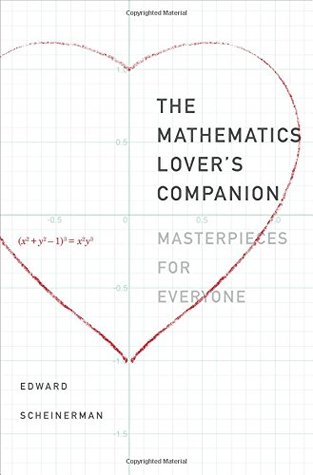
My two favorites for the year were “The Mathematics Lover’s Companion” by Edward Scheinerman and “Foolproof” by Brian Hayes. I’m a sucker for what I call “buffet” books (that cover several different topics briefly, instead of focusing on a single theme), and these both fall in that category. Even though Scheinerman’s book covered mostly well-worn topics in math I really enjoyed his writing and approach. Despite topping my own list, I didn't see the volume get a lot of publicity, and suspect that is only because the publisher, Yale University Press, may not spend much time/effort on promotion. I definitely recommend it, especially for young up-and-coming math enthusiasts and teachers.
Brian Hayes’ book is as well, a sort of “buffet” of more quirky, unpredictable topics (essays he had previously written), given Hayes’ excellent analytical treatment. Your ‘mileage may vary’ but I have to believe most math lovers will enjoy these two selections, covering a variety of topics, that top my picks.
The rest of the mentions I’ll list in no particular order…

More “buffet” offerings arrive via Mircea Pitici’s “Best Writing on Math” series. This year we actually got two from him, with “The Best Writing on Mathematics in 2016” showing up early in the year and the 2017 edition appearing recently. Pitici’s selections are always so broad and varying that in addition to the pieces I really enjoy there are always some others I don’t care for, making it hard for him to compete with my top two choices. But so glad he’s there offering this smorgasbord year-after-year.

Many 2017 books had a greater focus on niche areas, of interest to certain readers, but with perhaps less broad appeal. Two that I’ll mention dealt with subjects I think inherently interesting to most math lovers:
A Most Elegant Equation” from David Stipp is an entire volume on Euler’s famous identity, e^(iπ)+1=0 , generally considered the most beautiful equation in all of mathematics. Though a few curmudgeons argue the equation is not that beautiful or inspiring (and Stipp deals with such claims in the book), most I suspect, think otherwise and for that reason alone will enjoy the volume. I especially liked the final, more philosophical chapter where Stipp deals with what ‘beauty’ even means in mathematics.

Unsolved” by Craig Bauer could probably be organized or written a little better, but again the topic, unsolved codes/cryptograms over time, is so inherently fascinating it will likely pull most folks in, especially with some of the more familiar ones that readers have encountered and wondered about at one time or another.

Moving on, statistics and probability continued to be popular topics in 2017. I’ll only note two volumes:
From Persi Diaconis and Brian Skyrms came “Ten Great Ideas About Chance.” I thought this was going to be another popularized account of probability for lay people, of which there have been several recently, but it’s actually a more technical work, better as an adjunct text in a class than for a general audience. Once again I especially liked the final chapter on Hume, Bayes, and induction, but every chapter has value often touching on ideas not always stressed in probability courses. There is also an excellent probability tutorial in the Appendix. If probability is a major area of interest for you, you will want to look at this take.
Then from Steven Miller, comes the prodigious (700 pg.) “The Probability Lifesaver” — again suited more for the classroom than a general readership. An impressive compendium of probability topics and problems for anyone specializing in that area.

Next, how about some biographies. I’m still waiting for someone to top Siobhan Roberts’ 2015 treatment of John Conway ("Genius At Play"), but these are worth consideration:
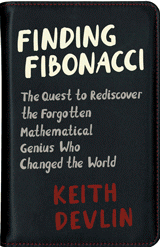
Keith Devlin dug deep into history, and clearly had fun doing so, to tell the story of Fibonacci in “Finding Fibonacci.” Meanwhile Ian Stewart, never allowing a year to pass without producing a book, gave us “Significant Figures,” a historical look sketching 25 great mathematicians. I found the second half of the volume more engaging than the first half, but if you lack short bios of many famous mathematicians on your bookshelf this one will do nicely.
A tangential book I enjoyed was “A Man For All Markets” by and about successful stocktrader Edward O. Thorp. Some, but limited, math — in fact the math is some of the drier, duller material — but many interesting anecdotes about life on Wall Street and elsewhere from a very intriguing individual.
A book I haven’t yet read, but looks good, is “A Mind At Play” by Jimi Soni and Rob Goodman, a biography of Claude Shannon.

Two other books I haven’t read but don’t mind citing are “Arithmetic” by the always interesting Paul Lockhart, and “The Joy of Mathematics: Marvels, Novelties, and Neglected Gems That Are Rarely Taught in Math Class” from Alfred Posamentier (again someone who churns out at least a book per year, and this one appears to overlap much of his previous output).
Two other popular books worth noting are “Beyond Infinity” from Eugenia Cheng (especially if you need a good primer on infinity for your bookshelf), and “The Calculus of Happiness” a quirky, practical, self-help guide from Oscar Fernandez.

And finally, I can’t let an offering from Marcus du Sautoy go unnoticed. “The Great Unknown” is a slightly encyclopedic volume covering a wide range of science topics and questions. In its scope, it reminds me a bit of Sean Carroll’s “The Big Picture,” if you are familiar with and enjoyed that volume. 

Even with all this, I’ve left out dozens of math-related popular books from the year, but hope you or a few folks on your list will enjoy some of the above.


Sunday, November 5, 2017

A Little Catch-up on Books


Won’t have time to do adequate blurbs (let alone full reviews) of all the books I’m reading now but will mention just a few of those I’m enjoying most, for a general audience. 
Volume I last finished was Ian Stewart’s Significant Figures,” his new compendium of biographical sketches of a couple dozen famous mathematicians — the writing is not as scintillating as some of Stewart’s other offerings, but adequate, especially if you’re looking for succinct profiles of mathematicians from ancient through William Thurston. The first half of the bios (and they’re in chronological order), had an almost cut-and-paste feel to it (to me), while the writing for the more modern half was more interesting/engaging. 
Oddly, after finishing the new Stewart volume I stumbled upon his much older “The Problems of Mathematics” (at a garage sale) which is a wonderful read and overview of mathematics (a bit dated in parts), and highly recommendable.   
And 3 more current books in my queue at the moment:

Ten Great Ideas About Chance” — have barely started it, but coming from Persi Diaconis and Brian Skyrms looks quite good, though I’m tiring a bit of the many popular treatments of chance/probability/statistics in the last 3 years. Still, an important topic, and leafing through it, the volume does appear to have a somewhat fresh take and organization.

The Best Writing In Mathematics 2017 — Micea Pitici’s latest entry in his ongoing series (the 2016 edition also came out earlier this year, so two in one year!). The volume is, as usual, a very wide-ranging collection of writings/topics from 2016, as Pitici shows again how “panoramic” and “versatile” mathematics really is. Some of your favorite popular math writers from the internet are included, and it is handsomely produced by Princeton University Press.  I couldn’t detect a theme or prevalence of topics in this year’s edition, just the usual disjointed variety that Pitici brings together.
He mentions at the end that he has switched his own career focus over to library science now, from mathematics, and I’m not clear if that will affect his production of this volume in the future (though I suspect not).

A Most Elegant Equation by David Stipp — How could you go wrong writing about everybody’s favorite equation in mathematics, Leonhard Euler’s  e^(iπ)+1=0.  Even when the writing is a bit dry or stodgy the topic is so inherently interesting as to pull you along. 

These are all books that will make my recommended list for end-of-year Holiday shopping, but several other books of a more specialized nature have crossed my desk the last few months, and I’ll probably leave them un-noted.


Sunday, October 8, 2017

Overview... "Foolproof, and Other Mathematical Meditations"


"Mathematics is too important and too much fun to be left to the mathematicians." 
                             -- first sentence of Brian Hayes' Preface to his new volume


One of my favorite Murphy Law corollaries states, “Nothing can be made foolproof because fools are so damn ingenious”... while the quote doesn't pertain to Brian Hayes' new book, it was the first thing I thought of upon seeing his offering. ;) The quote, I think, does pertain to the world we live in, and Hayes is nothing, if not an astute observer of that world.  “Foolproof and Other Mathematical Meditations” is a compendium of 13 updated versions of previously-published Hayes' essays with the “Foolproof” essay actually being the last, and one of the most enjoyable, of the slim volume. But before I say more, let me digress further…

A common joke when I was growing up reading Scientific American, was that the magazine was just a wrapper for getting Martin Gardner’s monthly column into your mailbox. No doubt there literally were some readers who subscribed to the magazine just for Gardner's column. His writing was succinct, descriptive, intriguing, on topics that were unpredictable from month-to-month. Another reason I think many loved Gardner was that he was NOT a mathematician (if memory serves me right he never even took an academic math class after high school) — it gave some hope that non-professional math enthusiasts could still contribute to the field or at least communicate some math to others (in the sciences usually astronomy is often cited as one of the only areas where ‘amateurs’ have a fair chance of making a significant contribution).

Anyway, I mention all this now because Brian Hayes’ writing, to my sense, has the ring of Gardner’s popular writing. In fact, when I interviewed Hayes awhile back, I specifically asked if he consciously copied Gardner’s style (he overlapped with Gardner, working at Scientific American). He admitted, like so many, being a huge fan of Gardner, but said he never deliberately tried to mimic Gardner’s craft — but took my question as the compliment it was meant to be. Still, as I read these ‘Foolproof’ essays I could almost hear Gardner’s voice in the background. Martin’s writing was more “recreational,” perhaps even casual, while Hayes has a more technical or academic bent to it, but still the style and step-by-step presentation are similar. And the resemblance goes beyond their meticulous exposition, as Hayes too is not a professional mathematician, just a sort of dabbler in it, who like Gardner, is unpredictable in what topic may capture his interest next.

Enough about all that. Hayes' new book is a delight… with one shortcoming: at 200 pages and 13 essays it is too SHORT. I don’t know what the criteria was for essays that made it into this volume, but plenty of good Hayes material is left out.

Every offering here contains interesting little gems or tidbits that I suspect a math teacher could incorporate into a classroom discussion at the middle or high school level, while also containing many bits for the professional mathematician to mull over. Computer science is Hayes’ specialty, so several of the pieces are focused there. My own favorites, in addition to “Foolproof" though are the more mathematically-inclined pieces, including: “The Spectrum of Riemannium,” “Playing Ball in the nth Dimension,” and “Quasirandom Ramblings.” But your own favorites will depend on your own proclivities as Hayes jumps around from one wild, quirky musing to another, on biography, method, pure and applied math: Gauss, arithmetic, Sudoku, space-filling curves, statistics, Markov chains, pi, computer software, randomness, math history, the abc conjecture, and more are here… almost always dipping in deep enough at some point to make you slow down in order to grasp what he's positing.

This rich, mind-stretching book has come along at a time when I was feeling a bit frustrated by the lack of “generalist” popular math books showing up this year (plenty of books appealing to narrower niches), and will certainly be among my favorites from the last 12 months. Reading it reminds me a bit of what they say about Chinese meals… each essay here felt deep and satisfying while reading it, yet an hour later I was hungry for more! ;)

Finally, Hayes’ dedication for the book reads: “To the mathematics community that has taught me and charmed me.” He constantly returns that charm in spades.


Monday, June 12, 2017

For Alan Turing Wannabes


Newly showing up in bookstores, “Unsolved” by Craig Bauer will likely appeal to a wide audience — didn’t  ALL of us math-lovers at some time play with cryptograms as a kid… and many carried that interest into adulthood. And even many others, without a direct interest in math, carry a fascination with the mystery, game-playing, and intrigue of ciphers.
This is a 500+ page imposing volume from Princeton University Press.  Though I’m not particularly fascinated by cryptography in general, I found the chapters on some of the most famous/familiar cases (the Voynich Manuscript, the Zodiac killer, the Cicada internet ciphers) quite gripping. There’s hardly any actual math in the volume, but of course solving cryptographic messages is very much an activity of thinking mathematically, so I feel justified to speak of the book in the popular math category, and don’t doubt mathematicians will find it interesting (the author is a mathematician himself).

Included are a few ciphers that have been solved, as examples, but the book very much concentrates on UNsolved ones. So for those who like working on such things there’s loads of work/play here (and the volume has an associated website for even more followup; also toward book’s end the author casually mentions the possibility of an eventual 2nd volume coming out).  Most of these ciphers were new to me, though I suspect for those really plugged into this subject many will be very well known.
I found myself more engrossed in the contents of the volume than I’d expected because unsolved cryptographic messages (and the minds that create them) are so inherently interesting, and come in so many different forms/contexts; and they stretch across centuries right up to modern times and modern technologies. The book ends with a chapter on potential communication with extraterrestrials, and description of RSA cryptology. Worth noting also, that it is possible some of the ciphers included are hoaxes and utter nonsense, but even figuring that out would require great effort/detective work.

It will be interesting to see if a book like this, offering up these mysteries to a new hive-mind of readers, may produce some solutions in the near future to long-unsolved cases. And if you do solve any of them, the NSA may wish to talk with you about job opportunities ;)

 Here are a couple of older YouTube videos of author Bauer speaking on his topic:


Sunday, May 28, 2017

Mathematician, Gambler, Hedge Fund Chief…


“A fascinating insight into the thought processes of someone with little interest in fame, who has mostly stayed under the radar, but who has followed his inquisitive mind wherever it has led him, and reaped the resulting rewards. There is nothing more important than knowing how to think clearly. Read this book and learn from a master.” — Paul Wilmott

A further look today at a volume I mentioned a short while back, “A Man For All Markets” by (and about) Edward O. Thorp.  It may not be thought of as a popular math read, but I think there is just enough math in it to qualify.

For any who don’t know, Ed Thorp is a trained mathematician, who taught for awhile, before following his heart and delving into games/gambling/Las Vegas and later the stock market and Wall Street… with, one should quickly add, remarkable success! This book tells the autobiographical story of his incredible life. 
Thorp started by figuring out (mathematically) winning strategies for gambling endeavors like blackjack, roulette, and baccarat before moving on to run very successful mutual/hedge funds on Wall St. If you have no interest in the financial markets than this bio may not grab you, but as most people do have some interest, it contains pages that will draw in most readers. His many life accomplishments make it seem easy to just apply basic logic to various situations, including the stock market, and succeed, yet most people consistently fail at such efforts.

The book reminds me slightly of Siobhan Roberts’ account of John Conway, "Genius At Play," from 2015 (my favorite volume of that year), but it is not nearly as fun a read. The similarity comes from two iconoclastic and brilliant figures telling the anecdotes of their lives. But Roberts’ lively, engaging writing and Conway’s antics lifts her excellent portrayal to  another level. In comparison, much of Thorp’s volume is duller, the writing often more stilted or bland, but still his anecdotes are fascinating enough to pull you in. Stories around his gambling pursuits, the rise and fall of his own hedge fund (Princeton Newport Partners), the Black-Scholes options-pricing formula, his take on the Bernie Madoff affair, his contrarian analysis of the traditional “Efficient Market Hypothesis,” and take on the 2008-9 market crash, are among many interesting passages sometimes couched within more stodgy, matter-of-fact material. I especially enjoyed the last few chapters and "thoughts."

One thing I also liked about the volume is the way it portrays an individual who relied heavily on “intuition” to launch most of his successful ventures, before his technical brilliance fleshed out all the details required. The central importance of intuition, passion, and curiosity sometimes gets lost in the focus on logical deduction among mathematicians, and Thorp implies that he succeeded where others failed because of his greater intuitive grasp of situations more so than keener logic.

A longer, more detailed review of the volume available here:

I do recommend the book, especially to anyone with an interest in the many machinations of Wall Street, but it’s not the most riveting read around, despite many entertaining parts.


Monday, April 17, 2017

"The Calculus of Happiness"


Oscar Fernandez’s slim “The Calculus of Happiness” is a somewhat quirky popular math entry focusing on using math (very little calculus involved) as an aid to one’s health, wealth, and love life. No doubt some will find the book entertaining and enlightening depending on your interest in these 3 topic areas. And it’s nice to see a book devoted to showing the public how basic math applies directly to common areas of the public’s interest.

Part 1 deals with diet/eating/nutrition. Of course entire (and large) tomes have been written on these topics that Fernandez is devoting less than 40 pages to. Still, Fernandez distills much helpful, practical info into a small space, touching on several different subjects. 
In a similar way, I think the last (3rd) part on dating and relationships is a succinct, entertaining treatment, reducing some human complexity to algorithms and modeling.
Part 2 of the book, on the mathematics of financial matters was the one of most interest to me. The interesting take-home argument of the second part is that, overall, a portfolio of investments split about 50/50 between stocks and bonds is best for the long haul. That’s a more conservative approach than most argue in favor of, but Fernandez makes a strong case that if you’re not interested in trading or following your investments closely, than such a buy-and-hold approach with 50% stocks/bonds makes sense (it’s essentially a sort of turtle versus hare approach; sacrificing some gains in the best years to guard against major losses in the bad years, and sleep better at night!).
Each chapter of the book (there are 2 chapters to each Part) ends with a helpful little summary of the main mathematical and non-mathematical take-home points from the chapter, as well as some 'bonus practical tips.'

Your interest in this book will be largely determined by your interest in the 3 subject areas… on the one hand these are three areas that are already well-covered elsewhere to the point of overkill… on the other hand, they are covered so much, specifically because they are areas of continuing interest to so many people.
At less than 150 pages the volume is a quick read, and the Parts need not be read in the order given if your inclination is otherwise.
There are also 6 Appendices which flesh out more of the math that is touched on in the body of the book.

MAA review of the volume is here:

...and the author is interviewed at the Publisher's page here:
http://blog.press.princeton.edu/2017/03/22/oscar-e-fernandez-on-the-calculus-of-happiness/


Sunday, March 12, 2017

3 Books In the Queue…


I’d actually enjoy a respite from reading… but popular math books keep showing up!  Currently in my reading queue are 3 new volumes, so 3 quick blurbs today on:

Finding Fibonacci” by Keith Devlin
Beyond Infinity”  by Eugenia Cheng
The Mathematics Lover’s Companion” by Edward Scheinerman

Regular readers here know I love Keith Devlin’s writing… BUT primarily when he’s explicating mathematics or logic. I’ve never had much interest in math history pre-19th-century, so didn't read Keith’s earlier book/biography ("A Man of Numbers") of the mathematician we know as Fibonacci. His new effort, "Finding Fibonacci," is, again more historical, biographical, and travelogue, than mathematical, so, early on (about 75 pgs. in.) it’s not particularly grabbing me. It’s even quirkier though because it’s a book about how he wrote the prior book (an odd self-referential stroke of authorship) — one can sense Keith’s own passion about the subject and the research/detective path it put him on, but you probably need more interest in math history than I have to fully appreciate it, or, if you read/enjoyed the earlier volume you'll want this follow-up (… ANYthing by Keith is worth reading, but I do find his greatest talents in translating mathematics to a general audience). Also, am happy to see Dr. Devlin is with Princeton University Press with this volume.

For whatever reason, infinity seems suddenly to be a hot topic… it’s plenty interesting of course, I just don’t know why there’s such a current spate of writing about it, but somewhere Cantor is smiling. ;)
Anyway, Eugenia Cheng’s 2nd book (after her success with “How To Bake Pi”) is “Beyond Infinity.” The early pages (I’m not far in) are pretty standard fare on the topic (i.e. chapter 2 is entirely on Hilbert’s Hotel), but Dr. Cheng is a fine writer and glancing ahead, where she gets deeper into the weeds of infinity, l anticipate the material getting more interesting, varied, and challenging along the way. There are a lot of good introductions to infinity out there (Ian Stewart has a new one out as well), and no doubt Cheng’s will take its place among that group.

The Devlin and Cheng books arrived as review copies, but a few days ago I stumbled upon a new volume, in a brick-and-mortar store, I’d NOT seen/heard any buzz about, by Johns Hopkins mathematician Edward Scheinerman, “The Mathematics Lover’s Companion.” Immediately loved the title and so far, am loving the content as well… it’s divided into 3 parts on “Number,” “Shape,” and “Uncertainty,” with bite-size writing on a wide swath of topics within each part (23 total chapters; I would almost say mini-lessons) — some topics fairly well-worn, but others less-so. The prose is excellent, terse and clear (and Scheinerman has won previous MAA awards for his writing). 
The book reminds me a bit of Strogatz’s “The Joy of X,” in its layout of successive essays, but a notch or two more advanced for the lay reader. So, especially if you enjoyed Strogatz’s work and are ready to step up for something a bit more challenging, grab this volume. I imagine even well-read math fans will find parts of the volume fresh and useful, and I also suspect it will be one of my 3 favorite books at year-end wrap-up! A very nice, exciting surprise find. As one reviewer synopsizes, An elegant sampler of many beautiful and interesting mathematical topics. This could become one of the best books available for a popular audience interested in what mathematics really is.”

Anyway, these are just quick takes, subject to change, and I’ll try to offer final opinions at some later date, but for now I especially recommend checking out the Scheinerman volume.


Monday, March 6, 2017

The Best Picks From Mircea Pitici


"The main message of this series is that there is a lot more to mathematics than formulas and learning by rote -- a lot more than the stringency of proof and the rigor usually associated with mathematics (and held so dear by mathematicians). Mathematics has interpretative sides with endless possibilities, many made manifest by writing in natural language."

-- Mircea Pitici in the book's Introduction


When I began math-blogging almost 7 years ago I worried whether I could possibly find enough popular math material to blog about for more than a few months. In addition to the Web itself, Mircea Pitici’s yearly “Best Writing on Mathematics” volume is a great reminder of just how much accessible math there is! Popular math not only doesn’t get old or constraining, it seems to be growing in leaps and bounds.

Every year I end up saying ‘this year’s edition [of Pitici's effort] seems like the best one yet.’ And so it does (this is the 7th in the series). It is beautifully-produced (from Princeton University Press), on high-grade paper, with excellent illustrations, layout, and production values, in addition to a fine, varied selection of contributions. 
The downside is, you pay for all that: I’m afraid the retail price of $32.95 (for a paperback) may hurt sales compared to prior years… time will tell (and of course depending where you get it, many/most won’t pay the full retail price).

It's nice to see how many entries this year come from pieces either on the internet or at least from folks with a solid presence on the Web; an indication of how much GREAT math content is now freely available to millions of people via their computers. So if you follow the math blogosphere or Twitterverse several of these contributors will be very familiar to you:

Andrew Gelman
Erica Klarreich
Kevin Hartnett
David Castelvecchi
Brian Hayes
Tanya Khovanova
David Richeson
Steven Strogatz
Australian mathematician Burkard Polster ("Mathologer" on YouTube) gains the distinction of having 2 selections in this volume!

…and the volume ends with Ian Stewart somewhat recursively writing about how to write a popular math book.
…Just some of the 30 authors in this year’s edition.

As usual, the anthology is a mix of pure and applied math, and philosophy and history, as well as some pieces for more serious mathematicians beyond a general audience. Big data, education, statistics/probability, art, physics, are included along the way.
Also, as usual, I’ll warn the reader that due to publication lag time, these pieces are actually from 2015, so if you're disappointed to find some favorite 2016 article missing, wait for NEXT year’s edition and check again.

As always, Pitici is impressive with the eclectic diversity of his choices for inclusion. Any other mathematician taking on the task would likely come up with a very different volume than Pitici has… but that’s simply a testament to how much good material is available to choose from. Also, one of the best aspects of the volume is Pitici’s extensive listing of notable books from the prior year, as well as articles that were not chosen for inclusion, but nonetheless worthy of mention... i.e., this volume can lead to a whole lot further reading if one so chooses.

Last year’s edition had somewhat of an emphasis on recreational math (unlike prior editions), while Pitici notes that thematically many of this year’s picks “refer to the dynamic tension between the object and the practice of ‘pure’ versus ‘applied’ mathematics.”

A few favorite pieces are Erica Klarreich’s on “the Monster Group,” Davide Castelvecchi’s on Mochizuki’s confounding “proof” of the ABC conjecture, and Jorge Almeida’s on “Lottery Perception.” Jennifer Quinn’s entry on combinatorics is an especially fun, creative read. There are several historical pieces, with John Stillwell’s wide-ranging offering, “What Does Depth Mean In Mathematics” perhaps being the most interesting. Also, two back-to-back entries offer very different views (pro and con) of the reforms of Common Core. 
The anthology does not have to be read from beginning to end; the reader can jump around, but several successive pieces do hang together around a topic, and may be best read together.
I thought Derek Abbott’s “The Reasonable Ineffectiveness of Mathematics,” which appears fourth in the book’s lineup, might have been a more effective lead-off piece, as a somewhat contrary, thought-provoking read, arguing against Platonism and against the effectiveness of mathematics... a stand not often seen (I didn't find him convincing, but at least interesting and provocative). I also quite enjoyed Pitici's Introduction to this year's volume, so don't just skip over that.
Other entries cover wide-ranging, unpredictable topics, very clearly written, and each reader will find their own favorites.
Congratulations to Dr. Pitici on another job well-done, and to Princeton University Press for a very handsome edition that will please most anyone with a strong interest in 'the queen of the sciences.' Meanwhile, I saw so many fantastic math pieces last year I'm already anxious for Mircea's 2017 edition!


Sunday, January 1, 2017

Readings To Start the Year


First, some New Years resolutions (you know, just in case, stating them publicly makes sticking to them any more likely ;):

1)  More exercise and fiber, less sugar, sodium, & carbs
2)  More pickleball, birding, hiking, music, flossing (just kidding)
3)  #Resist, resist, resist

—————————————————————

Anyway, some nice readings to start the new year with, courtesy of John Brockman’s Edge group. Every year they respond to some broad science-tinged question, and this year’s query was:
What scientific term or concept ought to be more widely known?

Doesn't sound all that scintillating, but I'm very much enjoying the responses. Haven’t seen the book version in stores yet, but the online version has 204 contributors, and looks to me to be one of the best such Edge volumes in recent years because of the sheer number, diversity, and succinctness of thoughtful, fun nuggets written. Here are just some of the more mathematically-tinged replies, and there are of course a great many interesting, non-mathematics ones as well:

Keith Devlin on Number Sense

Sean M. Carroll on Bayes’s Theorem

Bart Kosko on Negative Evidence

Jason Wilkes on Functional Equations

Lawrence Krauss on Uncertainty

Siobhan Roberts on Surreal Numbers

Ashvin Chhabra on Scaling

Kai Krause On Average

Simon Baron-Cohen on Boolean Logic

Clifford Pickover on the Menger Sponge

Much good stuff!
Scott Aaronson also took part and posted about the Edge essays at his blog with more details, so check out his take:

Lastly, I’ll note Eric Weinstein’s entry on “Russell Conjugation,” having to do with our emotional/visceral, rather than cerebral, reaction to words/language -- this is a topic that comes up in General Semantics (a subject I’ve been emphasizing of late) and which impinges on our current political scene