...a companion blog to "Math-Frolic," specifically for interviews, book reviews, weekly-linkfests, and longer posts or commentary than usually found at the Math-Frolic site.

*********************************************************************************************
"Mathematics, rightly viewed, possesses not only truth, but supreme beauty – a beauty cold and austere, like that of sculpture, without appeal to any part of our weaker nature, without the gorgeous trappings of painting or music, yet sublimely pure, and capable of a stern perfection such as only the greatest art can show." ---Bertrand Russell (1907) Rob Gluck

"I have come to believe, though very reluctantly, that it [mathematics] consists of tautologies. I fear that, to a mind of sufficient intellectual power, the whole of mathematics would appear trivial, as trivial as the statement that a four-legged animal is an animal." ---Bertrand Russell (1957)

******************************************************************** Rob Gluck

Showing posts with label interviews. Show all posts

Sunday, June 10, 2018

Gary Smith.... Teaching In the Classroom and Beyond


Math-Frolic Interview #44


"Ronald Coase cynically observed that, 'If you torture the data long enough, it will confess.' Standard Deviations is an exploration of dozens of examples of tortuous assertions that, with even a moment's reflection, don't pass the smell test. Sometimes, the unscrupulous deliberately try to mislead us. Other times, the well-intentioned are blissfully unaware of the mischief they are committing. My intention in writing this book is to help protect us from errors -- both external and self-inflicted. You will learn simple guidelines for recognizing bull when you see it -- or say it. Not only do others use data to fool us, we often fool ourselves."
-- from the Introduction to Standard Deviations by Gary Smith


Gary N. Smith is an award-winning Professor of Economics at Pomona College in California (...which happens to be my wonderful alma mater — and though he’s been there 37 years, I graduated before he arrived, so we never crossed paths).
He’s also the author of several popular books. “Standard Deviations” is one of my favorite takes on statistics that everyone should know about.  He followed that up with “What The Luck,” a similarly entertaining, engaging volume on probabilities in major parts of our lives. And I also enjoyed his very readable and instructive “Money Machine,” a great introduction to the sort of “value investing” I believe in and wish I had started earlier in life!  Later this year he’ll be out with “The AI Delusion,” more on that below.
If you’ve missed any of his books you should check them out…

And now a little more:

***************************

1)  Tell us a little about your background and the path that led to your interests in economics and statistics?

Way back when (in junior high school?), I became fascinated with mathematical puzzles, including several of Martin Gardner’s books, such as The Scientific American Book of Mathematical Puzzles and Diversions and Fads and Fallacies in the Name of Science. I went to Harvey Mudd College, here in California, and I majored in math, but I was also on the debate team and the national topic my freshman year was, “Resolved that the federal government should establish a national program of public works for the unemployed.” I was drawn to economics for the same reasons that attracted many economists, including James Tobin, who would become one of my mentors when I went to graduate school at Yale:
"I [Tobin] studied economics and made it my career for two reasons. The subject was and is intellectually fascinating and challenging, particularly to someone with taste and talent for theoretical reasoning and quantitative analysis. At the same time it offered the hope, as it still does, that improved understanding could better the lot of mankind."

After earning my PhD in economics at Yale, I accepted a job there as an assistant professor, initially teaching statistics and macroeconomics. Then the Yale economics department asked students what courses they would like added to the curriculum and the runaway winners were Marx and the stock market. I wasn’t interested in Marx, but James Tobin was the chair of my thesis committee and would be awarded the Nobel Prize in Economics, in part for his analysis of financial markets. So, I volunteered to create a stock market course. I loved it because of the wonderful combination of mathematical theories, empirical data, and real world relevance. My main interests today are statistics and finance.

2)  When I thought about interviewing you and clicked on your webpage I discovered you have a brand new book on the way later this year, “The AI Delusion,” so go ahead and tell us about that. I assume from the title you feel a lot of what we hear/read about AI is overhyped? 
p.s., just curious too, have you ever ridden in a driverless car?

I have not yet ridden in a driverless car.
A few years ago, I wrote Standard Deviations: Flawed Assumptions, Tortured Data, and Other Ways to Lie With Statistics, which is a compilation of examples of statistical errors and mischief that I collected over the years. Recently, a lot of these errors and mischief come from data mining—ransacking data for statistical patterns, without being guided or constrained by any coherent theory. Big data and powerful computers have made the problem much worse because they make the data mining so easy.
For example, back in 2008, Chris Anderson, editor-in-chief of Wired, wrote an article with the provocative title, “The End of Theory: The Data Deluge Makes the Scientific Method Obsolete.” Anderson argued that,
"With enough data, the numbers speak for themselves…. The new availability of huge amounts of data, along with the statistical tools to crunch these numbers, offers a whole new way of understanding the world. Correlation supersedes causation, and science can advance even without coherent models, unified theories, or really any mechanistic explanation at all."

That is a dangerous argument. Too many people think that computers are smarter than humans and should therefore be trusted to make important decisions for us based on statistical patterns unearthed by ransacking data. For example, courts all over the country are using computer models to make bail, prison-sentence, and parole decisions based on statistical patterns that may be merely coincidental, but cannot be evaluated because they are hidden inside black boxes.
The truth is that, while computer algorithms are great and getting better, they are still designed to have the very narrow capabilities needed to perform well-defined chores, not the general intelligence needed to deal with unfamiliar situations by assessing what is happening, why it is happening, and what the consequences are of taking action.
Artificial intelligence is not at all like the real intelligence that comes from human brains. Computers do not know what words mean because computers do not experience the world the way we do. They do not even know what the real world is. Computers do not have the common sense or wisdom that humans accumulate by living life. Computers have no way of judging whether the patterns they discover are meaningful or meaningless, and when the algorithms are inside black boxes, no one knows.

3)  Since you're an economist and a statistician I’m curious if there are any specific economists and statisticians you would especially recommend for mathematically-inclined readers to follow on the internet (on blogs, websites, Twitter, Facebook, wherever)?

Nate Silver and Andrew Gelman are reliably interesting.

Also, besides your books do you have Web-accessible pieces you would recommend to readers wanting to get a taste of your own work?

I write regularly for MarketWatch and RealClearMarkets. Here is one column on black-box investment algorithms, and one on Bitcoin .

4)  In some places I see a push in secondary education for some sort of statistics and data science course to be a required part of the math curriculum (probably replacing one of the currently-mandated math offerings). Do you have any thoughts on that?

I was a math major, I love math, and I use math and write computer programs for almost all my academic research, but I think that a basic understanding of statistics and data science are more useful and relevant for most citizens. Understanding the difference between good data and bad data, the nature and limitations of statistical inference, and the dangers of data mining are essential.

5)  When you’re not trying to raise math and financial literacy in this country ;) what are some of your other main interests/hobbies/activities?

I used to play soccer, squash, and all sorts of sports but I had to have knee replacement surgery a year ago. Now I’m mainly trying to be a good husband and father.

***************************

Thanks Gary, I've never before interviewed either an economist or a Fighting Sagehen (Pomona mascot) here, so thanks for two firsts! ;)
[In retrospect, I'm only sorry that you weren't the 47th interview here (...inside joke)]
And again, Gary's books are fun... AND timely reads if you're not already familiar with them.


Sunday, March 11, 2018

James Dilts.... mild-mannered mathematician and blogger


Math-Frolic Interview #43


"[James Dilts] works as a mild-mannered mathematician by day and as… well… a mild-mannered mathematician by night. The Missus disputes the mild-mannered part. Despite the best efforts of his middle and high school teachers, he discovered that math is awesome, and has decided that everyone else needs to know this too. His academic research is some combination of general relativity, differential equations and differential geometry, which he promises is super cool. He has an Erdös number of three."

                                           -- from James Dilts' blog


Dr. James Dilts is the proprietor (with his wife) of the "Infinity Plus 1" blog which I  stumbled across a bit over a year ago, and have enjoyed since. His posts aren't particularly frequent, but always cover some interesting, and sometimes difficult or unpredictable topic, in a lively, entertaining, well-planned-out fashion (with "the Missus" adding the illustrations). He definitely has a knack for writing. While currently a west-coast post-doc, he has plans to leave the "panic mode" of academia for possible opportunities in computer programming. And here's more:

----------------------------------------


1)  Tell us a little about your background that led to a major in mathematics.

Honestly, I have no idea how I ended up as a math major. My family growing up was more science-y than most. (My 3 older brothers are all programmers, for instance.) But, I didn't have any particular role models at all. I didn't know a single professor. I'm not even sure how I learned that "mathematician" was a valid job! But, sometime in high school, I decided I wanted to do research, and figured that I'd try math first, and if that didn't work, switch to physics or chemistry. I went to Brigham Young University for my undergraduate, and my first year there I took the intro to proofs class. I loved it! When we covered Cantor's diagonalization proof (available on our post "A bigger infinity"), I knew that I wasn't going to switch to physics.

2) Is there any particular backstory to the name of your blog, “Infinity Plus 1”?

When I decided to start writing the blog, we of course wanted a name that was light-hearted and memorable. And every kid has, at some point, tried to pull out "infinity plus one" to win an argument, so it seemed like a good fit. It also was a great segue into our first posts, where I wanted to talk about Cantor's diagonalization proof, for obvious reasons.

3)  Your posts always have a light-hearted feel to them, even when you’re dealing with difficult, abstract ideas.  I get the feeling you have a lot of fun writing them. Do you have a couple of favorite posts that were especially fun or satisfying to write? And do you have any idea which posts have been most popular with readers?

The most popular question is easy. Every time we've written a biography post (for Cantor, Schwarzschild, and Godel), they've always been more popular than the rest. The Godel post, in particular, got picked up by some service, and ended up with about as many views as the rest of the posts combined!

Oh, I'm bad at "favorite" questions. I've only written posts about topics I feel passionate about, and that I think are super interesting, so it's kind of hard to pick. Well, if I have to pick, let's pick the black hole posts, of which there are a few, starting with Black holes suck. Black holes are something that lots of people know about, but very few people actually understand. It doesn't help that the mathematics uses graduate level geometry... So, in those posts, I got to talk about the actual mathematics behind these super cool objects, and talk about all the interesting things we still don't know. (Really, there are a ton of questions left about black holes, which I never got to cover. Ah well.)

4)  Who are some of your own favorite math/science writers (or, feel free to mention writers of any sort who have been important to you)?

Honestly, I've gotten most of my information from class and textbooks and talking to professors, even the fun stories. But probably the most important science writer for me was Isaac Asimov. Most people who've heard of him know him for his science fiction, which I love. But he also had a PhD, and wrote a lot of science essays about all sorts of topics, from mathematics to physics to nuclear chemistry to why it's a tragedy we have a moon. Sure, none of the science is up to date anymore, but I'd still recommend his essays to anyone. His style was always light-hearted, and though I didn't think about it till now, I'm confident he heavily influenced my own writing.

[...interesting, I grew up when Asimov was the most prolific science-writer around, but I rarely hear his name brought up anymore, except maybe in science fiction circles; as some folks know, he was also quite a limerick-writer, but I won't go there ;)]

5)  You write that “My research is focused on the Einstein constraint equations, a coupled system of non-linear elliptic equations, and related geometric problems, such as the (conformally) prescribed scalar curvature problem. The main goal is a complete parametrization of the set of solutions of the constraint equations.”

Is it possible to put that in more layman terms? ;)
And is this an area that involves more strictly abstract or pure mathematics, or applied math as well?

In normal, Newtonian gravity, initial data is arbitrary, which means that you can plop down planets wherever you want, and feel free to evolve them. Newtonian gravity won't break. But relativity is different. In general relativity, your initial state of the universe has to satisfy certain conditions, and those conditions are the Einstein constraint equations. Now, unlike some equations, there are a lot of solutions to the constraint equations. 

One goal is to try to understand all the possible solutions to the constraint equations. One way to approach that is to try to parameterize all of the solutions, which means that if you give me some inputs x, y, and z, then I can turn around and give you a unique solution. That turns out to be a difficult problem. My research has focused on trying to find ways to show that the equations do or do not have solutions for certain inputs. 

It's a pure mathematical question, but numerical techniques have been helpful. Relatively recently, we realized that no one really knew what the right thing to try to prove was, which makes it really hard to prove anything. It was a huge road block. So, we used some numerical techniques to figure out what was going on, which turns out to be much more complicated than anyone had thought.

6)  I believe you’re currently job-hunting (coming off of a post-doc) and looking more into computer programming… say a little about what you’re most looking for in a new position or in the future?

I want to continue to work on interesting problems. A lot of programming jobs are just making another app, or working on the company's website and backend. Those are important jobs, but not what I want to do. Programming can be a powerful tool for investigating difficult questions, as I saw in my research, and my ideal job would let me contribute to that.

7)  Besides your blog, are there any social media or other websites where readers can particularly look for you?

I'm actually anti-social media! I have a Facebook page and a Twitter for the blog, since many people want to receive them in that way, but I'm otherwise completely off of Facebook and Twitter and all the usual culprits. I'd much rather spend my time on more important things.

8)  When you’re not doing mathy sorts of things, what are some of your favorite activities/hobbies/interests?

I'm an avid rock climber and unicyclist. I also love reading, especially classic science fiction, and playing games of all sorts. Of course, a lot of my time is spent making sure the Epsilons [my kids] don't destroy the Missus!

----------------------------------------

Thanks for participating here James, and take care to keep your rock-climbing and unicycling separate, OK! ;)
Hope too you find what you desire in a computer career, and hope your clear talents for writing and explaining continue as well in some form!
If you've never read James' blog before, definitely check it out; you're in for a treat!
(His list of posts/topics is HERE.)


Tuesday, June 20, 2017

Ed Scheinerman.... Seeing Masterpieces In Mathematics

Math-Frolic Interview #42


I fear that too many people’s mathematics education is devoid of joy. Imagine if children’s reading education focused primarily on  spelling and punctuation, but not on delights such as Harry Potter or creating stories of one’s own; that approach would hardly instill students with a love of literature.
-- Ed Scheinerman


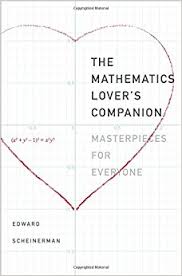
Thus far, Dr. Ed Scheinerman's "The Mathematics Lover's Companion" is my favorite popular math book of this year. It's a buffet of somewhat typical math topics that are well-worn in other volumes, but Ed's specific mix and engaging writing style about what he views as "masterpieces" of math-thought, help raise the volume above most of its counterparts. The 23 chapter headings from the Table of Contents give you a hint of the content, but not of Ed's fresh, clear writing style (he has previously won awards from MAA for his expository writing):  
https://www.ams.jhu.edu/ers/books/math-lovers-companion/

I definitely recommend the volume to budding math enthusiasts, and seasoned ones as well!
I was happy to get Dr. Scheinerman's responses to a few questions:

—————————————————————

1) Just by way of introduction can you briefly recount your own path to becoming a professional mathematician?

From about grade 7 on I was very fortunate to have had excellent mathematics teachers. Geometry was almost entirely doing proofs; proof was a wholly unexpected concept for me and greatly sparked my interest. Of particular importance though was my 10th grade mathematics teacher, John Wells, who emphasized mathematics as a creative subject. He encouraged and supported my mathematical interests, including advocating my application to the Hampshire College Summer Studies in Mathematics led by David Kelly. Attending that program was undoubtedly the most important catalyst in my path to becoming a mathematician.

[...currently, Dr. Scheinerman is a mathematics professor at Johns Hopkins University]

2)  Your prior writing seems to be mostly technical or academic in nature… what made you decide to write a “popular” math book, and who would you say the book is primarily written for?

I find that most people do not have a good sense of what mathematics is about. It seems to me that all the “good stuff” is left out of a typical high school curriculum. It is not unusual for me to meet people that know what a prime number is, but have no idea (and likely never considered) that there are infinitely many or how one can prove this. Showing that there are infinitely many primes is certainly accessible to high school students. 

We don’t teach English to students just so they can read instructions and write advertising copy. Were we to teach English the way we teach mathematics, we’d omit reading any Shakespeare and students would conflate spelling and literature, just as most people conflate arithmetic and mathematics. I recall (with horror) attending a presentation by a highly distinguished journalist who quipped that he “could never understand what an isosceles triangle was” and the audience laughed in agreement. 

My goal therefore is to provide a bit of an antidote: to present exciting mathematical topics that are accessible at the high school level that readers can enjoy.

3)  What might you say sets your book apart from many other volumes that cover similar topics… or why might someone familiar with these topics still enjoy reading your volume?

I tried in this book to “get to the point” for my reader. One can purchase entire books on (say) the number Ï€ but I sought to give my reader a “tasting menu” of great mathematics in which each chapter stands independent of the others. That way the reader can skip around, or put the book aside for a while to return later for another round of fun.

4)  What were some other subjects you considered for inclusion in the book, but in the end didn’t make the cut as math "masterpieces”?

I struggled mightily to write a chapter about the Axiom of Choice. I was not able to present it in a way that I thought my readers would find intelligible and interesting. I think it’s just too technical and the path to interesting consequences (e.g., nonmeasurable sets) too difficult for my intended audience.

5)  Who have been some of your own favorite “popularizers” of math over the years?

Without doubt one name stands above all others: Martin Gardner. I avidly read his Scientific American column and his many books.

[...Martin, a non-professional-mathematician, would no doubt be heartened, yet surprised, at how often his name comes up in this context!]

6)  The first two parts of the book essentially cover elements of algebra and geometry, fitting topics for a math volume, while Part 3 is about “Uncertainty” (a favorite topic of mine). Can you say a little about how that came to be the third big subject area of the book?

I must admit that the organization of the book arose after the chapters were written. I had (nearly) two dozen independent chapters and sought a way to arrange them. The broad headings of number, shape, and uncertainty worked.

7)  Do you have any further “popular” math books in mind to write?

Both I and my editor are encouraged by the positive reception this book has been getting (including a shout-out in the New York Times Review of Books) so I’m working on a Mathematics Lover’s Companion, Volume 2. My first chapter is written and it’s a “do it yourself” introduction about mathematical research that will demonstrate the process (including some of the frustration and then the joy) of mathematical discovery. It should be widely accessible even to folks whose algebra has completely rusted.

[...this is great to hear about!]

—————————————————————

Thanks for the answers here Dr. Scheinerman; very much looking forward to your next volume (and hoping you find a way to include the Axiom of Choice! ;)


Sunday, February 26, 2017

Francis Su... A Mathematician For All Seasons

Math-Frolic Interview #41


"What I hope to convince you of today is that the practice of mathematics cultivates virtues that help people flourish.  These virtues serve you well no matter what profession you choose.  And the movement towards virtue happens through basic human desires.
"I want to talk about five desires we all have.... 1) Play... 2) Beauty... 3) Truth... 4) Justice... 5) Love... "

                                   -- Francis Su (farewell address to the MAA)


When I do interviews here it usually takes me awhile to choose a title for the interview... for some reason, with Dr. Francis Su "A Mathematician For All Seasons" almost immediately jumped to mind as just seeming to fit. I hope all those who know Dr. Su personally, or experienced his farewell address at the 2017 joint math meetings, agree! 
Dr. Su is an award-winning professor at Harvey Mudd College, one of the Claremont Colleges (my old stomping grounds) in Southern California, and recent past President of the MAA.
His well-received farewell address is here:

His homepage is here:

...and he tweets at: @mathyawp

I'll let him tell you more about himself via the questions:

————————————————

1)  Your wonderful MAA retirement address (“Mathematics is for human flourishing”) to the Joint Meetings in Atlanta in January was one of the most linked-to math tweets I’ve seen since I’ve been on Twitter. Can you tell us briefly how that talk evolved for you. Was it a long or quick process, and did you know well ahead of time what you wanted to impart?

Since being elected as MAA President, I knew I'd have to give this speech. I also knew if I chose to give a standard math talk, I'd have regretted missing an opportunity to speak about important issues facing our community.  Given the racial turmoil facing our country, the lack of diversity within our profession, and my unique position of being the first MAA or AMS president of color, I knew I wanted to address the theme of inclusion. And that the best way to do that would be to first paint an inclusive vision of why we do mathematics, and connect that to deep human themes. So I had the threads of the talk almost a year before, but I didn't start writing in earnest until December. I was nervous and kept rewriting my talk. But if I had started any earlier I would have just kept second guessing myself even more!

2)  Within math circles we often see “mathematics” associated with “beauty” or “science” or even “wonder,” but connecting it to “human flourishing” was somewhat novel on your part. Was the word “flourishing” a sort of epiphany for you, or is it a term you’d long linked to math?

I'm a fan of philosophy and theology, and the term 'human flourishing' is actually popular in philosophical and theological circles as describing the well-lived life. But connecting it to math happened when I was discussing my ideas for the talk with a good friend.  So I suppose you could call it an epiphany.

3) As I ask most interviewees, do you recall what first attracted you to mathematics, and when did you know you wished to pursue it professionally?

I discovered by love for math as a kid.  My parents gave me math books to read and I enjoyed working on puzzles.  I began to get a glimpse of real math when my dad gave me a book on Fermat's Last Theorem.  That book had a proof that every Pythagorean triple is of the form (p^2-q^2, 2pq, p^2+q^2) for integers p, q.  And I thought that proof was beautiful!

4)  Tell us a little about your own specialty interests within the field of mathematics…

These days I study geometric and topological combinatorics. You can think of that as combinatorial problems where geometry or topology play a prominent role. So, for instance, the study of triangulations of polyhedra. A question I've worked on is: what is the minimal number of n-dimensional tetrahedra you need to build an n-dimensional cube? A unique niche I've carved for myself is applying mathematical methods from this area to answer questions in the social sciences.

5) If you were dropped on to a desert island with at most 3-4 math-related books to occupy your time (and mind), what would they be and why? And how about non-math books?

Yikes. I'm not a fan of re-reading books so the books I'd most want to have are probably ones I've not read yet!  So maybe I'd ask good friends to choose for me. If I can't do that, I suppose the math books I'd take are: (1) a book of solved problems, e.g. puzzles or a set of inquiry-based notes in some subject I wanted to learn, (2) a book of unsolved problems and (3) math historian Glen Van Brummelen's The Mathematics of the Heavens and the Earth: The Early History of Trigonometry.  That last book might be handy while stargazing on a desert island.  Non-math related books I'd take are (1) the Bible (for personal devotional reading), (2) Les Miserables by Victor Hugo (a favorite book), and (3) a book about survival skills or ship-building. :-)

6)  If you could pick one deceased mathematician (who you never knew) to sit down and have coffee with and discuss mathematics, who might it be and why?

Blaise Pascal, for sure. I'd love to discuss both mathematics and theology with him.  

7)  Given the ongoing harsh arguments about how secondary math education ought proceed in the U.S., how confident are you that it is headed in the best (or at least, a good) direction?
Also (optional), do you care to express any concerns about math/science education, more generally, going forward under a Trump Administration?

I think secondary math education is generally headed in a good direction. For instance, the Common Core is a good set of standards and most states have some version, even if (due to political posturing) they rejected the title Common Core.  More needs to be done by all of us to support our teachers, to ensure that curricula (which aren't part of the standards) are written well, and to discourage schools from going overboard with testing (a separate issue from the standards). 

It remains to be seen what happens to math/science education under a Trump Administration, but I do think we need to help our students see that facts matter, that telling truths matter, and that their math education really can help them to think critically about the claims they encounter and to be people of intellectual integrity. 

8)  When you’re not doing math, what are some main interests/hobbies/activities you enjoy?

I enjoy photography and gardening. For similar reasons as why I love math: there's beauty in the interplay between structure and freedom, and there's playfulness and artistry in the choices I make.

————————————————

Thanks Dr. Su for participating here, and more importantly for your years of service/devotion to the math community. And may structure, freedom, playfulness, and artistry be a part of all our lives as you so encourage!


Sunday, December 18, 2016

Grant Sanderson…. An Eye for Math Video Instruction

Math-Frolic Interview #40


"Hi Grant, Thank you for making math videos. When I watched the topology video, I was hanging on the edge of my seat in suspense as if watching Game of Thrones, while enjoying the beauty of the problem, the solution, and simply the graphics and animations."
-- a commenter at Patreon


With strong interests in both math and computer science, Grant Sanderson now produces some of the best, most cutting-edge, entertaining and instructional math videos out there on his 3Blue1Brown YouTube site. When you see the beauty and quality of his videos you'll understand how he has turned this into full-time work.  I believe Steven Strogatz was the first to bring Grant’s work to my attention, and you know when Steve recommends something it’s going to be good. 
Grant describes his effort this way:

3Blue1Brown is some combination of math and entertainment, depending on your disposition. The goal is for explanations to be driven by animations and for difficult problems to be made simple with changes in perspective.

He also has a Patreon account here:

And now a little more about him:

----------------------------------------------------

1)  You run an amazing math video site on YouTube, “3Blue1Brown.” How many hours per week or month, approximately, do you spend working on that?  And how do you decide what to cover with each new video you do?

It's hard to speculate on specific hour counts.  For one thing, it's only relatively recently that I started doing this full-time, so the honest answer is that I don't have enough data to answer yet.  Also, the question seems more applicable to occupations with less of a work-life blur than I have.  For example, when I read math, does that count as work towards 3blue1brown?  What if some of it eventually makes its way into a video?  When I work on improving the animation tool, but not for a particular video, is that work or just a side-project?  In general, I'd say I work quite a lot, but the word "work" doesn't really do justice to what a playful process it is.  

As far as deciding on what to cover next, there's just a long list of things that I think could make good videos, and every time I have a thought or come across something I think is worthy it goes on the list.  The more interesting question is how to sort the list, and for that I try to prioritize ideas that I don't think are commonly expressed elsewhere on the internet, and which strike the right balance between approachable yet deep.

2)  We’ll go back to some basics:
What is your academic background and your current professional/career role? 

I studied math and CS as an undergrad at Stanford.  The original plan was to continue on the PhD track, and my later years at Stanford were spent increasingly in graduate classes in preparation for that.  But I personally wanted to spend a few years out of academia before doing so, even though for whatever reason that is a less common thing to do.  After graduating, I worked as a content creator for Khan Academy, making things related to multivariable calculus.  At the time, I spent my nights/weekends working on 3blue1brown as an unassociated side-project.  Thanks to the huge support people showed for 3blue1brown, this is actually what I do full time now.  With things going how they are now, and given that I've always tended more towards the teaching/outreach side of math than the research, it's looking less and less like I'll return to the PhD path.  Maybe that's why more people don't take those years in-between.

3)  You say at one point on your site that you’ve “loved math for as long as I can remember.” Do you recall what initiated your interest in math, and when did you know you wished to pursue it professionally?

My dad, definitely.  Even though he would tell you that his own math education ended earlier than he would have liked, sometime shortly after calculus, he has a great appreciation for beautiful problem solving.  That appreciation was matched by his eagerness to pass it on to me, as embodied by the countless times he exposed me to neat puzzles and patterns when I was young.  I remember a particular game when I was very young where he’d stack sugar cubes in some interesting geometric way, and if I correctly gave the number of cubes in the configuration, he'd give me one as a reward.

Beyond that, I had the good fortune of some caring and encouraging math teachers to bump up my interest as I grew up.  I am particularly thankful to Phil Sakashita, my calculus teacher, who did more than almost anyone else to open my eyes to what math could be.

As far as going into it professionally, it was probably sometime in high school that I thought becoming a mathematician would be incredibly cool.  But somewhere in college, I actually toggled to the CS side of things, and had you interviewed me then I would have been quite certain that my future lay somewhere in software or data science.  But at the end of each tech internship that I did, I found myself lamenting the fact that I wasn't doing more math, so I decided to switch gears and point myself towards a math career.

4)  Any idea how long you’ll be putting new material on your site, or what’s ahead otherwise in your life, mathwise? Any special goals for the future you’re actively striving toward?

Right now, the focus is just on getting into a flow of regular content creation.  I'm working on an Essence of Calculus series behind the scenes, and I'll always be working on more "Essence of" series of some sort, so look out for those.

5)  You explain in a FAQ that the odd name for your site is a reference to an eye condition you have, “sectoral heterochromia,” and you say the name puts “a genetic signature on my work.” I’m not quite sure what that means or why it was important for you; can you flesh that out a little more?

I'll be the first to admit that making this my logo is somewhat strange, but my right eye is 3/4 blue and 1/4 brown.  When I say it puts a "genetic signature" on my work, I mean that just as other people put their names on their work, I chose to put a little piece of who I am in a different sense.  The more important point, though, is that the channel is about seeing things, so an eye is somewhat fitting.

6)  Increasingly, there’s more and more competition online for math videos and instruction. Do you have some favorite other sites that you don’t mind recommending to folks? 

Mathologer is, of course, great.  And for classrooms, I really like the work that Desmos is doing.  The Art of Problem Solving site/books/courses were influential for me growing up.  Also, "How to fold a Julia Fractal" is a must-see for anyone not yet familiar with it.

7)  And how about books?… I’m always interested to hear what ‘popular’ math books were especially inspiring to a math enthusiast, that you’d recommend to others?

Again, I quite liked The Art of Problem Solving books growing up.  Vladimir Arnold's book on ODEs is fantastic.  John and Barbara Hubbard's "Vector Calculus, Linear Algebra and Differential Forms" is great for any early undergrad hoping to get a deeper feel for what they're learning.  Munkres' "Topology" (of course).  Cox's, "Primes for the form x^2 + ny^2".  There are also these three little books on number theory by Kato, Kurokawa and Saito which are a delight, though probably best read with a supplement.  "Proofs from the Book" by Aigner and Ziegler is just filled with gems of cleverness.  Larson's "Problem solving through problems".  Many of Terence Tao's books are great, especially the one on measure theory.  I'm sure I'm neglecting some great ones, but those are what come to mind right now.

8)  When you’re not engaged in mathematical pursuits, what are some of your other interests/hobbies/activities?

I enjoy playing violin and mandolin, and pretending like I know how to play guitar, bass and piano.  Hiking and running are also solid default activities.  I do some private teaching on the side, which I count as a hobby because I do it for my own pleasure.

----------------------------------------------------

Thanks Grant, hope any readers not already familiar with your site will check it out soon. It's like having a mini-college math education at your fingertips... and the price is right!