...a companion blog to "Math-Frolic," specifically for interviews, book reviews, weekly-linkfests, and longer posts or commentary than usually found at the Math-Frolic site.

*********************************************************************************************
"Mathematics, rightly viewed, possesses not only truth, but supreme beauty – a beauty cold and austere, like that of sculpture, without appeal to any part of our weaker nature, without the gorgeous trappings of painting or music, yet sublimely pure, and capable of a stern perfection such as only the greatest art can show." ---Bertrand Russell (1907) Rob Gluck

"I have come to believe, though very reluctantly, that it [mathematics] consists of tautologies. I fear that, to a mind of sufficient intellectual power, the whole of mathematics would appear trivial, as trivial as the statement that a four-legged animal is an animal." ---Bertrand Russell (1957)

******************************************************************** Rob Gluck

Showing posts with label Martin Gardner. Show all posts

Tuesday, December 13, 2016

Martin Gardner Helped Wreck My Country…

Martin Gardner
Alfred Korzybski

[Bit of a long ramble ahead through some things on my mind for awhile.]

We’ll start with a news story (…because we live in this wonderful time when you get to make up any damn thing you want and pass it along as "breaking news"):

==> According to top-classified PRIME Security documents uncovered by TMD special investigator Alexus Jones, the Donald Trump we see is in fact an electronic Slovenian-built, fully-programmable cyborg under direct control of long-time Moscow operative Melania Kvorninski and her Russian handlers (no one has ever seen him actually use a rest room for example). 25 years in the hatching, this sinister-plot is scheduled to reach fruition in mid-2017, with complete dissolution of the American military and Congress.

Que sera sera…. (p.s… by the way, NOBODY can prove the above false; that's the beauty of fake news, where more layers of lies can simply be added on).

Moving on….
There were many factors of course for Hillary Clinton's election defeat, but the simplest is that James Comey’s late intervention torpedoed her campaign, halting her momentum and moving many undecideds (cringing at the possibility of hearing about emails for the next 4 years), over to the Trump side. Without that single news event all indications are HRC would've won, and of course she DID win the popular vote handily. But with that said, at least the Comey announcement was an actual news event. 
Another factor getting a lot of attention lately is all the “fake news” reports that got passed along (and believed) as real by the unaware (or dare I say, the none-too-bright)… some of it so ridiculous on-its-face as to bode ill for Democracy’s future! Which leads me to the two topics I want to raise here. Because... what-the-hell is wrong with people's basic critical thinking skills these days!?

American demographics are changing; specifically the percentage of older people, say 70 and over, is far greater than in the past relative to the number of young people, say 30 and under. Medical/health advancements and lower birth rates mean age proportions are becoming more skewed all the time.
But ANOTHER potential skewing is FAR more controversial...
It has been called "dysgenics" or "retrogressive evolution" (the opposite of eugenics). Unfortunately, controversial Nobel-Prize winner William Shockley brought the idea to public attention decades ago, though it well-precedes him in the biology community. If you remove notions of race and IQ from the discussion, the more general concept is worth reviewing as a partial explanation for the anti-intellectualism, anti-science, anti-establishment, and fringe views prominently on display these days. 

Shockley spoke out at a time that the "Zero Population Growth" movement, family-planning, and widespread access to birth control were spreading across America. In brief, his idea was that the most educated, most successful, most fit individuals were primary practitioners of these new trends, while the least educated, least successful, and least fit, were largely unaware of, or uninterested in, such trends. In short, the most fit, capable couples were often deliberately limiting families to 2-3 children at most, while their less fit (less capable) counterparts were more likely to have 4 or more offspring, who in turn grew up in less ideal conditions, received less education, were generally less fit or successful, and continued the cycle — self-perpetuated skewing (of ability and education). 

70 years since the world collectively said "never again," the rise of xenophobia, anti-semitism, isolationism/nationalism, anti-elitism, anti-science, and simplistic-thinking across the globe is unmistakeable, and may coincide with factors Shockley noted decades ago. 
[An alternative explanation for recent political events specifically in the U.S. is that the right-wing have always been a part of the American populace, but were not very active politically in prior generations. Beginning in the 1960’s the Republican Party deliberately set out to contact, mobilize, and activate conservative rural and fundamentalist elements (the "Silent Majority" as it were) through targeted mass mailings and talk radio... and now also with digital social networking. They were successful -- millions who were never previously active in politics now are.]

In any event, if the numbers of less-educated, less critically-thinking people have risen in recent decades (partly perhaps because dysgenics, mathematically-speaking, may be baked into the demographics), then widespread quality education and social services may be the only antidote to all this. Which leads me finally to Martin Gardner….

The greatest skeptical mistake Gardner ever made, in my opinion, was his derision of non-Aristotelian "General Semantics."  While some elements of G.S. (and its founder, Alfred Korzybski) are easily critiqued, the broader intent and purposes of G.S. were admirable. G.S. fundamentally trains people to be aware of the many ways, words and language manipulate thinking, perception, decision-making. In short, it assists in 'critical thinking,' in dismally short supply these days. 
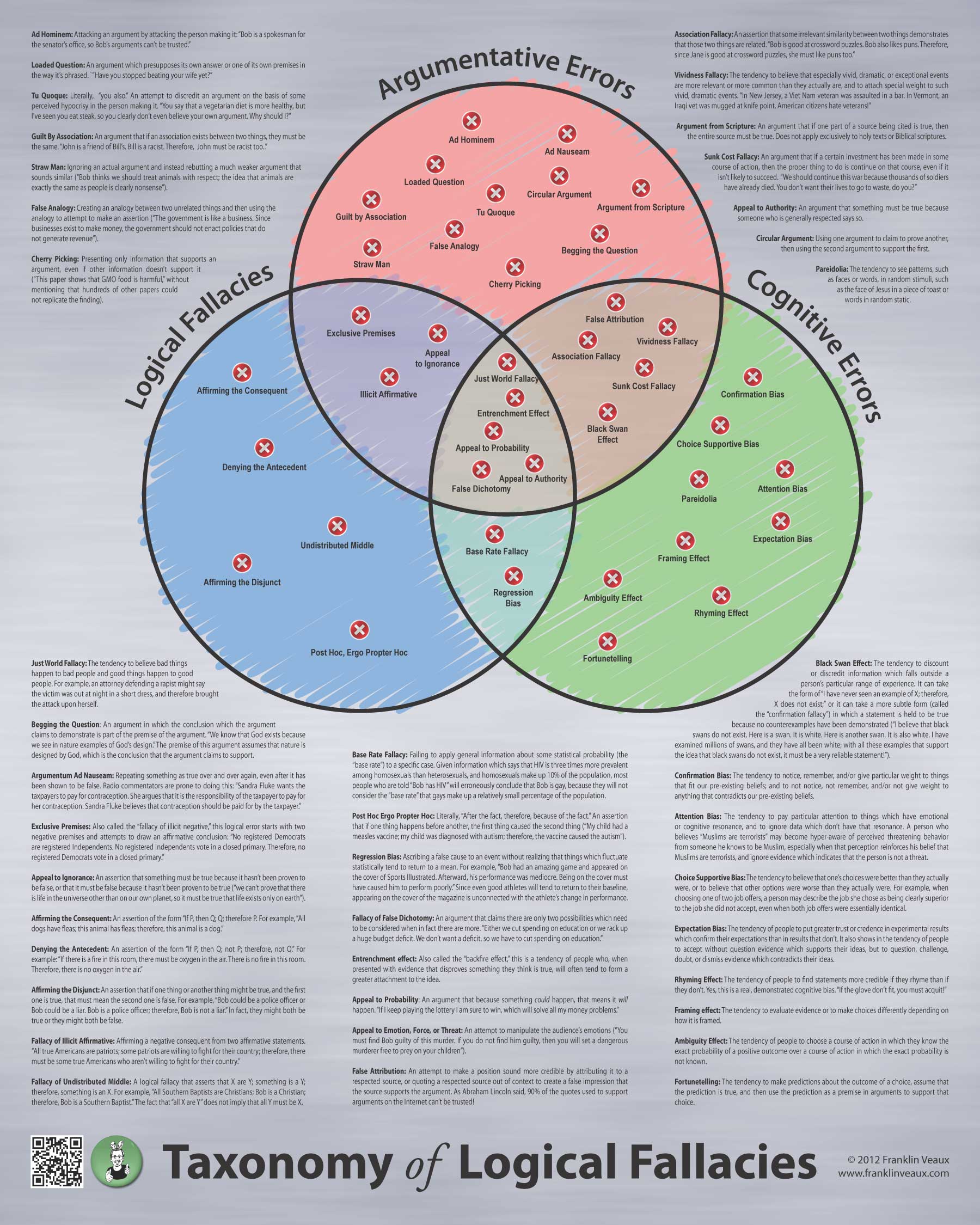
Gardner, of all people, should have been a fierce adherent of G.S.; instead his scorn helped make it a fringe field, doing for G.S. what Noam Chomsky did for “behaviorism” in psychology. In fact I don't know of any way to teach people critical (and skeptical) thinking without employing tenets from General Semantics. They are simple and basic, yet often not internalized by people without some instruction. G.S. inculcates a wariness of language in advertising/marketing, politics, relationships, religion, news-coverage, and even science, and a recognition of the subtle dogmatism that infuses so much communication. On a sidenote, here are a couple of popular 'taxonomies of logical fallacies' which actually relate back (unknowingly) to a number of G.S. basic principles:

http://www.obsidianfields.com/lj/venn-poster3-large.jpg
https://yourlogicalfallacyis.com/poster
(You may be able to embiggen them on your screen for better readability, or download them -- they ought be somewhere in every high school, IMO!)

Seriously, it amazes me that secondary students are forced to read Shakespeare or Dickens or Hardy, but never taught rudiments of how language operates on our cognition, a far more important faculty in today's world.

I won’t try to summarize G.S. principles here, and I haven’t kept up with G.S. volumes over the years, but two of the early popularizations (there are many) that most influenced me were:
Language In Thought and Action  by S.I. Hayakawa
The Tyranny of Words  by Stuart Chase

In its own way, Alan Sokal’s “Beyond the Hoax,” which I’ve referenced here before, also touches on many of these issues. I was recently a bit miffed to see Ben Goldacre, in a tweet, imply (if I interpreted it correctly) that Sokal’s hoax may have actually contributed to the large-scale mistrust people now exhibit towards science and academics. I don’t think that’s true at all; on the contrary Sokal’s target was specifically 'postmodernism,' and some of the ’softer’ disciplines that brush on a veneer of science, but not science or true expertise itself. We need more Alan Sokals, not fewer, to combat the growing anti-elitism, anti-science sentiments thriving today.
Anyway, at the bottom of the page I’ve also tacked on a couple of weblinks that further detail the whole rift between Gardner and G.S. Some people even viewed G.S. as a “cult,” in part probably because L. Ron Hubbard was said to have incorporated parts of it for his early “Dianetics” program, but many of G.S.'s principles were broad enough that they could be employed in any number of programs.

In fairness to Gardner I will note that he was less critical of the “popularizers” of G.S. than of its foundations and some of its technical notions.

In his autobiography Gardner uses an example of how "E-prime," a G.S. idea that never caught on (which advocated avoiding all forms of "to be"), would alter some simple doggerel... E-prime version on left, standard in parentheses on the right:

Roses look red  (Roses are red)
Violets look blue  (Violets are blue)
Honey tastes sweet   (Honey is sweet)
As sweet as you

Now, I suppose to many (like Gardner) these may seem trivial, innocuous changes, but buried in language/words are deep meanings/mindsets and effects, and the effects of these two versions ARE different (the first being more accurate, less dogmatic; the second being assertive, but unprovable and potentially inaccurate). Emotions, prejudices, ambiguity are intrinsically buried and maintained in our language use. I’m a bit flummoxed that a writer as clear and incisive as Gardner didn’t show a deeper grasp of how words (dangerously) manipulate people.

Or take a different simple sentence: “Mary had a little lamb.” 
Sounds simple; you likely think you understand it. But in fact you CAN’T really understand it without more context because it has too many possible meanings. Just emphasizing different words shifts the meaning:
MARY had a little lamb.
Mary HAD a little lamb.
Mary had a LITTLE lamb.
Mary had a little LAMB.

And putting these varying sentences into different extended contexts can further significantly alter what is being said. The point is that routine language (that we take for granted) is very imprecise and ambiguous, yet people react to it as if it is clear and explicit. I’m using minor examples here, but there are far more nefarious ones out there in the world (especially in this day of bountiful conspiracy theories and lies).

There is some irony that a spurned figure like Shockley was perhaps prescient in foreseeing where the U.S. was headed, while Gardner’s much-touted skepticism led him to rebuke one program that could have prevented this electoral outcome; prevented the very gullibility and irrationality he spent his adult life battling.

Properly taught at young ages, General Semantics, would be an antidote to the nationalism, anti-elitism, anti-intellectualism we now face. Though it is still around, G.S. basically flopped back in the 50s/60s, shortly before the time that Shockley began worrying aloud about dysgenic factors in this country. 50 or 60 years later a demagogue gets elected President of the U.S. Well, no shit Sherlock!! ;-)
As a self-described “democratic-Socialist,” Gardner would be spinning in his grave (or wherever), at this year’s election outcome. But I’m here to say, even if a bit facetiously, that he was unknowingly partially responsible. 

Meanwhile, between now and mid-2017, beware of thin-skinned, orange cyborgs….


p.s… an aside: I once briefly mentioned to Jim Propp my disappointment in Gardner’s failure to take General Semantics seriously, and he countered that every fan of Martin has some one beef with Gardner; some particular thing they think he got very wrong. So rest-assured, in that context, I still consider myself a typical, inveterate admirer of Martin.

For anyone wanting to know more about the Gardner/G.S. clash here are a couple of pages that go into further detail:


ADDENDUM:  Found it a bit serendipitous that the latest post from Ben Orlin deals with “the catchy nonsense of ‘two negatives make a positive'” — this is at least somewhat similar to some of the issues General Semantics deals with in pointing out language’s weaknesses. In turn, this brings to my mind also, Keith Devlin’s longstanding crusade against teaching “multiplication as repeated addition” (it is NOT). And I’ve pointed out here before, math puzzles where the actual math or logic is simple, yet the language used easily leads people astray to wrong answers. In short, even mathematics (or at least math education) is not immune to the imprecise, misleading nature of words.


Tuesday, October 1, 2013

Undiluted Martin Gardner…


Part of Douglas Hofstadter's tribute to Martin Gardner upon learning of his death back in 2010 (this doesn't come from Gardner's autobiography, but from online sources):
"This is really a sad day. Not so much sad that Martin died, since we all knew it had to come pretty soon, but sad because his spirit was so important to so many of us, and because he had such a profound influence on so many of us. He is totally unreproducible -- he was sui generis -- and what's so strange is that so few people today are really aware of what a giant he was in so many fields -- to name some of them, the propagation of truly deep and beautiful mathematical ideas (not just "mathematical games", far from it!), the intense battling of pseudoscience and related ideas, the invention of superb magic tricks, the love for beautiful poetry, the fascination with profound philosophical ideas (Newcomb's paradox, free will, etc. etc.), the elusive border between nonsense and sense, the idea of intellectual hoaxes done in order to make serious points (for example, one time, at my instigation, he wrote a scathing review of his own book "The Whys of a Philosophical Scrivener" in "The New York Review of Books", and the idea was to talk about the ideas seriously even though he was attacking the ideas that he himself believed in), and on and on and on and on. Martin Gardner was so profoundly influential on so many top-notch thinkers in so many disciplines -- just a remarkable human being -- and at the same time he was so unbelievably modest and unassuming. Totally. So it is a very sad day to think that such a person is gone, and that so many of us owe him so much, and that so few people -- even extremely intelligent, well-informed people -- realize who he was or have even ever heard of him. Very strange. But I guess that when you are a total non-self-trumpeter like Martin, that's what you want and that's what you get." 


If you missed it, you can read my initial 'broad-brush' take on Martin Gardner's autobiography HERE; but ahead (as promised), a much l-l-longer read and heart-felt tribute to Gardner and his biography: 

That Martin Gardner was a "fideist" and a "mysterian," that his literary tastes were far-flung (including G.K. Chesterton, H.G. Wells, Frank Baum, Lord Dunsany, Miguel de Unamuno, Lewis Carroll), that he had little formal mathematical training yet inspired a slew of others to pursue such a course, that he was opinionated and outspoken while also being shy, humble, and unassuming, and that he was one of the finest thought-provoking writers I've ever encountered... made him, for me, one of the most remarkable individuals in all of Americana. I only wish his autobiography was twice as long, for I never tire of reading him and feeling enriched.

 This book is both simple and complex, befitting the simple and complex person it is about. I can just imagine Gardner begrudgingly laboring on this volume at the behest of others, and wondering why anyone would find his vanilla life interesting. The writing is terse, succinct, matter-of-fact, conversational, even rambly at times, neither flowery nor scintillating, yet still fluent and interesting; sprinkled throughout with Gardner's subtle humor, illustrative anecdotes and encounters with other interesting people. These words and stories coming from some ordinary individual might not even be worth relating, but coming from Gardner they rise to another level.

In a very brief single-page Preface to the volume, Gardner ends with these telling lines:
"The best known remark of stand-up comedian Lenny Bruce was that people are leaving their churches and going back to God. What follows here is a rambling autobiography of one such person -- me."
One thing I was elatedly surprised to read in Gardner's book was that he regarded "The Whys of a Philosophical Scrivener" as his "most important book" and "The Night Is Large" as his "second best book." I have always regarded these as my two favorite Gardner reads, but was flabbergasted that he would pick them out as well from all his prolific writings (…apparently great minds do think alike ;-)
"The Night Is Large" is a superb anthology of many of his best and most varied essays stretching from 1938 to 1995. Whenever I meet people who know of Gardner only as a recreational mathematician, this is the first book I recommend that they additionally read. "The Whys of a Philosophical Scrivener" is Gardner's 1983 treatise on his many underlying philosophical notions; never one of his most popular or well-known books, it is must-reading if you wish to understand the man behind the math and the skepticism. It is a book that surprised many when, despite that outspoken skepticism, he came out as a theist or what he characterized as a "fideist" -- believing in an indefinable God despite having no rational reason or argument for doing so (but simply out of emotional comfort). I was emerging from my own longstanding agnostic/atheist phase when I read this volume and discovered that "fideism" was about as close to any term I could find for my own newly-evolving belief (and apparently I had some good company).
Gardner's near-infatuation with Spanish philosopher Miguel de Unamuno was another surprise from "The Whys..." book. Prankishly, and no doubt realizing how many of his acquaintances would be shocked by the contents of the volume, Gardner wrote a scathing tour de force critique of the book, under an alias ("George Groth"), for the NY Times (only at the very end of the biting piece is the shenanigan divulged) -- one of his all-time best stunts (and there were many), apparently at the behest of Doug Hofstadter.
If you're interested in Gardner and haven't read these two volumes, they go on your to-do list.

I'll briefly overview the current autobiography's content, touching upon a few high points:

Chapter 1 begins with some almost random reminiscences from childhood, and establishes the author's penchant for dropping in little sidebar musings along the way. In telling of his mother's love of rainbows, Gardner reflects:
"Now that I am an old man, my heart still leaps up when I, too, see a rainbow. It made a high leap one morning when I saw a secondary bow. The wonderful thing about a rainbow is that it is not something 'out there' in the sky. It exists only on the retinas of eyes or on photographic film. Your image in a mirror is similar. It's not a thing behind the looking glass."
The next 3 chapters take us through Gardner's high school years (where he didn't get great grades, by the way), before chapter 5 has him heading off to the University of Chicago, where he would major in philosophy. Chapters 5-9 cover his life in Chicago (academic and beyond). Robert Hutchins was the then-famous President of U. of Chicago (creator of the "Great Books" movement), who developed many critics along the way… including Gardner. Gardner also reflects on Mortimer Adler, Richard McKeon, and Charles Hartshorne, three more philosophers at Chicago toward whom he is not particularly favorable. He was an acolyte though of Rudolf Carnap who visited Chicago. (...Ray Smullyan, Doug Hofstadter, John Conway, James Randi, Ron Graham, Persi Diaconis, are among the many others who do fare well in this chronicle.)
Gardner entered Chicago "in the grip of a crude Protestant fundamentalism" as he puts it, but there (as often happens in college) he 'lost his faith.' 
One particular story in these chapters helped explain an oddity to me:  One of the most unusual finds I ever made in a thrift store book section was a 470-page volume Gardner authored on the Urantia Group, "Urantia: The Great Cult Mystery" -- one of the oddest cults of all time; one based upon the bizarre 2000+ page "The Urantia Book." Why Gardner bothered to plow through 2000 pages of craziness and devote time writing an entire book to debunking the cult (and by his own admission he knew there would be limited audience for such a tome) I could never fathom; but in chapter 7 he explains (almost embarrassingly) that the Seventh-day Adventist origins of the cult is what drew his attention because he'd once been attracted to the religion himself, even though he admits the book project was probably a waste-of-time.

 For all my admiration of Gardner I sometimes found the severity of his skepticism objectionable. Several topics that he viewed as nonsense or rubbish I'd be less completely dismissive of (always leaving a crack open for more future information). My biggest disappointment with Martin was his complete rejection of "General Semantics." In chapter 8 he briefly discusses the subject (which he's covered more extensively elsewhere). His blunt criticism of its founder, Alfred Korzybski, may be partially on target, but I believe his negativity toward the more general movement was greatly off-base.
Where I attended high school a "course" in general semantics, based on S.I. Hayakawa's popularization of it, "Language In Thought and Action," was a one-semester requirement (embedded into an English course) -- to this day I consider it the single MOST IMPORTANT course I took in my entire academic life!; it perturbs me that Gardner (and so many others for that matter) failed to see the societal significance of it.  So while Gardner sang the praises of many literary figures for reasons I could barely fathom, he dissed one of the most important schools of thought I'd ever encountered (although he wasn't particularly critical of Hayakawa as one of its proponents)! Moreover, General Semantics passes along some of the critical thinking skills that makes one less susceptible to the very sort of 'pseudoscience' Gardner spent his life combating (but admittedly, Gardner, not I, was in the majority, as GS's strongest proponents over the years have been few-and-far-between).

Chapter 10 covers Gardner's turn to journalism and writing (having decided he didn't want to teach philosophy) and taking his first job in Tulsa, Oklahoma. Chapter 11 veers off to tell us about his parents (mostly his dad) and mention of brother Jim and sister Judith is also made.
Chapters 12 and 13 cover Gardner's time (4 years) in the U.S. Navy, which, to my surprise, he seemed to enjoy quite satisfactorily, and where he learned the nature of, and some control over, migraine headaches that had plagued him. He also tells amusingly about learning to 'toss in four-letter words' in conversation while in the Navy.

From the Navy, Gardner returned to Chicago where he wrote fiction for Esquire and then, believe-it-or-not, wrote for the children's magazine "Humpty Dumpty." He mentions that the last sentence of one rejected Esquire story, about a man who commits suicide, ran something like this: "The cut was a perfect geodesic, the shortest and simplest curve joining two points on his neck" -- ah hahh, hints of the Scientific American columnist yet to come!! The big break to SA came in 1956 when they published his first famous piece on "flexagons." ...And the rest, as they say, is history! Gardner explains, touchingly, that his own mathematical ignorance helped him, as he had "to struggle to understand what I wrote, and this helped me write in ways that others could understand."
Chapter 15, recounting so many of the highlights of his time with Scientific American is a wonderful read, and a great walk down memory lane for all who followed Gardner during those years. (By the way, I noticed that an early Rouse Ball puzzle book that Gardner references as one of his own early math recreation inspirations is freely available on the Web here: http://www.gutenberg.org/files/26839/26839-pdf.pdf ).

Chapter 16 delves into Gardner's "skepticism" and his unrelenting censure of "pseudoscience."  He was an early member of what today goes under the name "Committee For Skeptical Inquiry," a major "skeptics" group that he played a leading, vocal role in. I joined that group early as a dues-paying member, but dropped out some years later when it seemed clear to me that the Committee was not so much interested in "skepticism" as in "debunking" -- there's a difference -- true skeptics will still investigate a phenomena with open-minded objectivity in search of the truth, whereas debunkers go in with their minds pretty much already made-up and a specific purpose to debunk (one of the founding members quit the group around the same time and for the same reason I let my membership lapse -- I should add that I still have admiration overall for the work the Committee does). Moreover, the group aimed most of its fire at fringe or pseudo science where the pickings were easy, instead of academic science where it takes more bravery (and work) to call out critical shots.  True skeptics have to also be skeptical of science, of evidence, of data, of human endeavors, and even skeptical of skeptics! A lot of very weak/poor science creeps into so-called 'evidence-based science' and the line between the latter and 'pseudoscience' is simply blurrier than most pretend. In short, I often see 49 shades of gray ;-) where Gardner and others regularly painted things in black-and-white. It was, by the way, the sharpness and strict rationalism of Gardner's skeptical stances that caused many to be stunned by his religious disclosures in the "Whys … Scrivener" volume.

Chapters 15 - 21 are the volume's best parts (or perhaps just seem so because they cover the years when most of us were aware of Gardner). In addition to his SA experience, he covers his wife, family and friends a bit, and then in the very last (21st) chapter ("My Philosophy") recapitulates some of his deepest philosophical views, including mysterianism and theism -- I consider it the best chapter of the book and would almost recommend reading it first, except that it's likely better, as icing on the cake, after having read from start to finish. He classifies himself as a "Democratic Socialist" and names Norman Thomas as one of his heroes. I also enjoy his little rant against "modern art" in the final chapter. (An afterword to the book, by the way, is written by Gardner's long-time friend and fellow magician/skeptic James Randi.)

A couple of miscellaneous final remarks:

 Colm Mulcahy noted in a podcast interview that the headshot photos used for Gardner books always displayed a serious, dour-looking, even sour, face (and the same is true of the photos in this volume), even though in-person Gardner was warm, friendly, and puckishly humorous -- I've always presumed that Martin picked out those pics himself, and it says something about how he saw himself (but just my guess).

That Gardner lacked formal education in mathematics (taking no math courses beyond high school) has always been an inspiration to me, as a math blogger lacking the pertinent academic background for my own online endeavor. There are of course other math and science popularizers who cover their subject despite a lack of specific academic credentials, but Gardner was in a league of his own.

My only two disappointments with this volume are that 1) Gardner doesn't discuss math Platonism to any significant extent; a subject I love to hear him expound on; and 2) the book is too short! I could've easily read another 100 stories/anecdotes/memories from his past.

This particular volume, variously described by Gardner himself as "slovenly," "rambling," and "disheveled," probably won't win any national book awards for writing, but to his many fans it is most assuredly a prize!
Gardner softened his skeptical rationalism enough to carry a belief that there might be some sort of afterlife... a view many of his readers likely doubt (but perhaps he and Harry Houdini are playing cards somewhere as I write this ;-)). He certainly remains alive via the extensive legacy of books he left providing reading/thinking/learning material to last our own lifetimes. And thank you Martin for this last, final, further peek into your brilliant, fertile, curious, nimble, incisive, probing, captivating life and mind...

Finally, in case you wonder where the title of the autobiography stems from, it is from a stanza of poetry (actually known as a "grook") of scientist/writer Piet Hein that Gardner opens the book with:
"We glibly talk of nature's laws
but do things have a natural cause?
Black earth turned into yellow crocus
is undiluted hocus-pocus."

[On or around October 21 (his birthday), in various cities worldwide, annual "Celebration Of Mind" events take place in honor of Martin Gardner.]


Thursday, September 26, 2013

Gardner Sans Math


There's so much I want to say about Martin Gardner's new autobiography ("Undiluted Hocus-Pocus"); it will take much more application of pen to paper (or pixel to screen) to cover much of the ground, but a few broad-brush remarks today.

First, if you're a Gardner 'groupie' (and by that I mean someone who has enjoyed some of the full breadth of Gardner's prolific writings), of course, OF COURSE!!, read this book. It will be like having Martin over to sit in your living room in a big ol' lounge chair by the fireplace and casually pass along stories of his past to you. BUT (and this is where it gets tricky), if you ONLY know of Gardner through his recreational math writings, or if you're too young to even know those and only know him as a famous name, well, I'm less certain just how much joy this volume will bring. If you like biographies, you may still enjoy it, though it is not the rollicking tale some may want in a good biography. Gardner very largely led a 'life of the mind,' not a life of high, flashy adventure; almost a sedate life in many ways. And there is paltry little of mathematics in these pages (much more on philosophy, religion, literature), though he does relate stories about some of his most popular, well-known columns for Scientific American (his entire time spent with SA though, is but a fraction of the book). So if you're in search of mathematics or rousing life stories, you just might be disappointed. This is a quiet, mostly soft-spoken (even understated) chronicle from a man in his 90's looking back and re-telling scattered memories (no doubt because some people advised him there would be an audience for such a recounting). In his humility, he calls the volume at one point "this slovenly autobiography" and then later his "disheveled memoirs." His fans will love it; it's just harder for me to predict the reaction of those less admiring or knowledgeable of him in advance.

The book reminds me just a tad of Michelle Feynman's compendium of her famous father's correspondences, "Perfectly Reasonable Deviations from the Beaten Track: The Letters of Richard P. Feynman," another volume that contained many mundane, innocuous elements, but also so many bits of pure lovable Richard Feynman -- probably not very meaningful or engaging for a non-Feynman fan, but a treasure-trove to relish for anyone who is one.  Gardner's volume also has a fair amount of run-of-the-mill material, but always peppered with his thoughtfulness, intellect, and humor (no knee-slapping guffaws here, just anecdotes that put a twinkle in your eyes and a curl at the corners of your lips).

This book also reminded me of all the things I disagreed with Gardner on, yet how much I enjoyed reading his viewpoint even when I bristled at it (and there was of course far more to agree with than disagree with; moreover, we both regard ourselves as "Mysterians"). Those are some of the things I might touch on in a broader, more detailed review later. And then too I always found his eclectic taste in literature almost bizarre, but that too just made him all-the-more interesting a character to me. This book pulls back the curtain and reveals a little more of the almost inexplicable, unpredictable wizard that was Martin Gardner. He was not merely a man of numbers, but a brilliant man of letters and thought. And 3+ years after his death this book arrives as truly a gift.
Thank you, thank you, to Princeton University Press for bringing it to us, and at a future point I'll say more about its contents.


ADDENDUM: my much longer, more detailed review of Gardner's book is now posted here:

http://mathtango.blogspot.com/2013/10/undiluted-martin-gardner.html


Sunday, September 15, 2013

Colm Mulcahy... Let the Mathemagic Begin


Math-Frolic Interview #16 

"Follow your dreams while doing something worthwhile.  Share your toys. Cherish your family and friends..." -- Colm Mulcahy

For any who don't know of Colm Mulcahy I'll let him introduce himself to readers through the synopsis he sent along as part of this interview:

"Colm Mulcahy is a professor of mathematics at Spelman College, in Atlanta. Over the last decade, he has been at the forefront of publishing new 'mathemagical' principles and effects for cards, particularly in his long-running bi-monthly Card Colm for the Mathematical Association of America (MAA). He also blogs at the Aperiodical and the Huffington Post. Dr. Mulcahy has been a recipient of the MAA’s Allendoerfer Award for excellence in expository writing. His interests are broad, ranging from algebra and number theory to geometry. He earned a B.Sc. and M.Sc. in mathematical science from University College Dublin and a PhD from Cornell University for research in the algebraic theory of quadratic forms."

Here's a summary of places on the Web you can find Colm:

Twitter: @CardColm  https://twitter.com/cardcolm
author of "Mathematical Card Magic: Fifty-Two New Effects"
http://www.cardcolm.org
http://www.spelman.edu/academics/faculty/colm-mulcahy
http://www.maa.org/columns/colm/cardcolm.html ("Card Colm")
http://www.huffingtonpost.com/colm-mulcahy/
http://aperiodical.com/category/columns/maths-colm

One of the delights for me in interviewing Dr. Mulcahy, was that he was friends with Martin Gardner during the last decade of Martin's life, and so I took the liberty of inquiring a lot about Martin (almost like getting two interviews for the price of one! ;-) -- especially timely, since the annual "Celebration of Mind" (in tribute to Gardner) comes up next month. Hope you all enjoy these great responses as much as I did:

**************************************

1. You're both a magician and a mathematician… which interest came first, and have the two interests intertwined most of your life? Also, at what point did you know you wished to pursue math professionally?

I came to magic very late in life, in my early 40s.  Hence, combining that with my natural laziness, I’m a terrible magician.  Had I started at 14 like the rest of them, today I’d be good at double lifts, false counts, Charlier passes and the like.  So I have to resort to---gasp!--- mathematics, to entertain with a deck of cards.  What I do (and what’s in my book) is largely original creations. Forget clichés like dealing into three piles, basic addition or subtraction disguised, or casting out nines.  Those are hackeyed and pretty boring in my view!

As it happens, the only sleight-of-hand I can do is a perfect faro shuffle.  That took me a month to learn to get it right, after an intensive one-on-one tutorial from the ever-patient Mark Setteducati a decade back.  The only reason I stuck at that was because the mathematical possibilities fascinated me.

But what really fascinates me are the possibilities with a genuinely shuffled deck, or a slightly rigged deck, even after a riffle shuffle done by a spectator.  That’s what I’ve come to specialize in.  And none of my creations take advantage of perfect faro shuffles; that would put too much pressure on myself. Of course I take a dim view of crimps or other card marking.  I will include a little false shuffling, or tell a few white lies such as “I couldn’t possibly know what these cards are” for entertainment purposes, but the underlying principle of the magic I do has to be mathematical.

As regards my real career---the day job!--- when I started university as a teenager, I didn’t know that it was possible to focus just on mathematics, which was the only subject that made total sense to me then.  I had assumed I’d end up in science, like my brother before me, probably physics in my case.  But after six months I discovered that I could soon drop all yucky labs and do nothing but pure and applied mathematics coursework—what a revelation!   (This was in Ireland, where it was assumed that you already had picked up a decent liberal arts education in secondary school.) I went for it, hook, line and sinker, and never looked back.  I believe I’m still a student at heart, and a life-long learner.  The only real job I’ve ever had was the three years I served as department chair. For the past few decades I’ve actually been getting paid to study---I hope nobody finds out---and also to share the fun with others, they call that teaching, writing, publishing and presenting.

2. You're originally from Ireland… can you say what brought you to the States to begin with and do you get back to Ireland often?

I came over after doing my masters, back then it was impossible to get funded to do a PhD in Ireland.  I've been lucky to be able to get back often over the decades, at least twice a year these days.  Maths Week Ireland (www.mathsweek.ie) sometimes have me over, it's the largest mathematics outreach programme in the world (http://www.huffingtonpost.com/colm-mulcahy/math-weak-try-math-week_b_2008517.html), with over 130,000 kids getting involved last year. I spoke to 1000 of them myself, up and down the length of the country, in the course of my gruelling but fun 9 day "fall break".  The Maths in the Street activities are a hoot, because you get to engage curious people aged 8 to 80, who just go out to do their shopping and they get home with groceries AND a knowledge of the Towers of Hanoi, how to solve a maze, or a card trick they can do for the family.
[--We need more of that in the U.S.!]

3. You were a friend of Martin Gardner through the last decade of his life… are there any behind-the-scenes stories about Martin you can share that might interest my readers?

Martin was amazing. Humble, incredibly focussed and hardworking and productive.  So kind, and generous with his time and wisdom. We chatted on the phone and corresponded on and off from 2000 to 2006, when I finally visited him for the first time. By then he was in his 90s, and probably not as sharp as he’d been a decade or two earlier.  He was certainly a little forgetful: sometimes he didn’t remember that he’d already mastered something and written about it, but he could look it up quickly in his amazingly organized files, and it would come back to him right away.  And his less robust state didn’t stop him writing a half dozen books in his last five years, including the ace up his sleeve, his autobiography.

Back in 2000, I’d sent him about 50 Latexed pages of notes I’d made on mathematical card tricks---Latex is what most mathematicians use to typeset their work---largely stolen from assorted publications of his.  He responded with enthusiasm, and suggested I write a book on the topic.  I was flattered of course, but knew I’d have to come up with a lot more original material for that to be a reasonable proposition.  I set myself a personal goal of getting it published by 2006, the 50th anniversary of his landmark "Mathematics, Magic and Mystery," and found a willing (university) publisher.  I’m deadline driven: without one, a lot of things don’t get done.  With a deadline, they eventually get finished, although seven years late in this case, and with another publisher.  Along the way I decided to try to switch to the premier outlet for recreational mathematics, AK Peters (now part of CRC Press).  I was very happy that Klaus Peters offered me a contract and that I finally delivered the goods this year, before books become obsolete.

4. Gardner was surprisingly unpredictable in some of his viewpoints and interests… in your time with him was there any particular view he held or interest he had that most surprised you, or that the two of you debated over?

He tried to engage me in a debate once about whether I thought mathematics was discovered or invented, which is of course an old conundrum, and one he had definite views on.  Being the shallow person I am, I refused to be drawn in.  It never really interested me, though of course it should have. In more recent years, I have asked myself the same question in relation to mathemagical principles which I have stumbled on.  Did I create them out of nothing, or did I just get lucky and find them because I was kicking around in the leaves where nobody else before me had?  I still don’t know.  I probably should have paid more attention to Martin on this topic.

Following his death, many tributes assumed, as I myself had in earlier years, that he was either agnostic or atheist.  Not so.  I wouldn’t presume to speak on his behalf---we never discussed it and his views here are well documented in his own writings---but I believe he was a theist who did not believe in any organized religion.  That surprised me when I first realized it.
[-- Gardner covered this, and 'outed' himself as a "fideist," in one of my favorite volumes of his, "The Whys of a Philosophical Scrivener" -- a bit of an oddity among his works, and in some ways a dry read -- yet, made fascinating, by the chance to see how his mind worked on a very philosophical (less-empirical) level -- also, Gardner's high regard for Spanish philosopher/writer Miguel de Unamuno is made clear in this volume.]

One sweltering March day when I was visiting him, I spotted a curious object hanging up over the sliding door to the outside, and I asked him what it was.  It was a small musical saw. He confessed to playing it on rare occasion for relaxation.  Despite my gentle encouragement he made it clear that there would be no public or private performance, and I felt a little embarrassed, as if I had intruded on his privacy.

I never wanted to bother him unless I had something to share which I thought he’d really appreciate knowing about, but I did have a habit of phoning him now and then while waiting to board flights. The very last time I did this—about six months before his death---I ended the call as I often did by asking if he’d had any interesting visitors, and he replied in the negative, as usual.  After some prodding he perked up, and said he’d had one surprising visitor, which baffled him: Richard Dawkins.  He added something like, “I don’t know why somebody famous like that came to see me.”  I retorted, “Because YOU’re famous!” but he wasn’t having any of that.  I went on, pointing out that Dawkins had written much about theology and philosophy, just like he had.  He revealed that all they’d done was chat about life, and grandkids and baseball---Dawkins had just given a talk at the university nearby---until  his visitor stood up to leave because he had a plane to catch.  Then they both realized that there was a big topic they were supposed to discuss, and they sat down again and chatted intensely for 15 or 20 more minutes.  At this point I had a plane to catch myself---I was about to fly from Boston to Dublin---and I never got to hear the rest of the story.  Or, sadly, Martin’s voice again.  I'd grown very fond of him.  Such a sweet unassuming man, for such an intellectual giant.

[-- Wow, fascinating Dawkins story… easy to speculate that they could've had an 'intense' chat over the nature of religion or religious belief, but purely a guess; no doubt many possibilities. If any readers, perchance, know Dawkins well enough to ask him about it, I'd LOVE to hear what the "the rest of the story" is!
One of Gardner's most remarkable qualities (in my view) was his balancing act between being a strong skeptic and harsh critic on-the-one-hand, while also being humble/"sweet unassuming" on the other... opinionated, but not in a know-it-all kind of way; curious and uncertain of many things to the end.]

5. What are your own favorite aspects of mathematics to study or read about, and if you could only take say 3 or 4 math books with you to a desert island what might they be?

 I like surprises and counter-intuitive things which every graduate in all disciplines should know, such as not-so-obvious averages (http://www.huffingtonpost.com/colm-mulcahy/mean-questions-with-harmonious-answers_b_2469351.html) and non-Euclidean geometry. Most of us are smart enough to know that the earth isn’t flat, but is space flat?? I especially like things that teach us to distrust simple “numerical evidence”:  The false positive paradox. Simpson’s paradox. The Birthday Paradox.  Benford’s Law.  The Gilbreath Principle. There are probably five more of them out there that we all need to know about.  If anyone knows what they are, please tell me.

I really should have a good grasp of the basic history of mathematics. "Math Through the Ages" by Berlinghoff and Gouvêa is probably a great place to start.  I’m particularly interested in knowing about the contributions of all cultures around the globe, even if much of that was hidden until recently, or doesn’t “fit the mold.”

I’m woefully ignorant of topology, but if Pontryagin and Morin (both blind) could contribute so much to the subject, it wouldn’t kill me to learn a little.  I never really got quantum mechanics as a student all those years ago, it was the one topic I faked understanding, perhaps taking false comfort from the fact that Einstein didn’t buy it either.  I’m not that attracted to it, but if it was an undergraduate topic in the 70s, I should be able to handle it.

It’s time I understood the whole mathematics/music connection.  It might help if I actually knew something about music, but I’m strictly an avid consumer. 
[-- yes, I was surprised back in college days by how many music majors I ran into with math minors, or math majors with music minors! -- definitely an interesting connection]

Of course we should all study Diaconis and Graham’s "Magical Mathematics" daily.  If I could master half of the tricks in it, I’d die happy.

6. Do you have one mathematical-related achievement from your life that you're most proud of above others?

I suppose getting my first book out, twenty-five years after I first considered writing one, and after starting and abandoning two others!  The one just published bears no resemblance to anything I would have considered writing even fifteen years ago, and the people who trained me probably wouldn't recognize it as having much to do with mathematics, but it contains a lot of fresh creations. I hope it turns some youngsters on to the joys and possibilities of mathematics.

Starting in 2012, I've been blogging for the "general public", and not just for card magic aficionados as I do in Card Colm at maa.org.  I've written some things for the Huffington Post http://www.huffingtonpost.com/colm-mulcahy/ and also for The Aperiodical in the UK. http://aperiodical.com/category/columns/maths-colm  In recent times, both have taken a back seat due to the focus I needed to bring to getting my 380-page book manuscript to the printers, set up appearances and book signings and so on, but I plan to get back to that kind of blogging soon.

There's a big world out there that needs to have a better attitude about mathematics.  We've never had the best PR, and I aim to play a role in improving the image of the subject.  I've always had a big issue with the claim that people are either numbers or words people.  Many of us are both.  Some mathematics teachers are reluctant to correct basic spelling and grammar in their students' work, for instance, either on the basis that it's not their job, or it doesn't matter. Wrong!  It's all about communication, about being able to justify your position with a cogent argument using words AND numbers correctly. A string of numbers presented without accompanying text is hardly convincing, and may in fact mask the presenter's confusion or ignorance.  We all need to have a healthy skepticism of numbers and "experts" and learn to make informed decisions ourselves.  And be willing to change our minds in the light of compelling fresh evidence. Ironically, education is no inoculation against frauds and charlatans, whether they're peddling hokey stats or snake oil.  James Randi can confirm!

7. When you're not reading math or magic, what other types of reading do you like? And what other hobbies or activities do you enjoy?

Irish fiction. World history. Cookery books. Music, music, music.  I cook a lot and indulge in craft beers and chocolate more than is good for me.  I jog and am trying to bike more often, to atone for my sins.  Actually, I’ve always found that such outdoors exercise stimulates the mind.  Over the past ten years or so, some of my best ideas for new Card Colms have come to me while puffing and panting.  I am not alone in that regard (see http://www.huffingtonpost.com/colm-mulcahy/sports-and-mathematics_b_2475226.html ).

8. And back to Martin… You've been heavily involved with the "Gathering For Gardner" and "Celebration of Mind" (coming up soon in October) events which honor Martin Gardner's legacy.  Most Gardner fans are probably familiar with these events, but can you give a quick synopsis of them for anyone unfamiliar? And do you have a particularly memorable experience from one of these events that stands out for you over the years?

G4G is an insider and by-invitation-only conference held in Atlanta in March of even-numbered years.  They’ve being going on for 20 years.  They  attract very creative and interdisciplinary mathematicians, puzzlers and magicians as well as skeptics, illusionists, Alice afficionados, and so on.  Four or five days of extreme intellectual stimulation and networking.  You might meet some of your heroes, from Randi to Shortz, Conway to Penrose, Teller to Smullyan.   A few years back there, Erik Demaine announced that any two polygonal regions of the same area are hinge-dissection equivalent, meaning that the first can be cut into pieces and these swung around on hinges to form the second.  He got a standing ovation.  I was present when history was announced.  It was awesome.   I was able to tell my students at Spelman soon thereafter when I proved for them the much easier version ignoring hinges.  Who’d have thought it, a new math result proved in their college days that they could at least understand the statement of?

The 'Celebration of Mind' events were started in 2010, a few months after Martin died.  These are open to all, anywhere on the planet.  Anyone can host one or attend one---a few are strictly private but that’s not common.  They’ve happened on all continents and at both poles. They take place in and around October 21, which was Martin’s birthday.  We’d like this to go viral as well as global, especially with Martin’s centennial approaching in 2014.  There should be thousands of them each year, celebrating the triumphs of the human mind with cool stuff Martin made us think about:  recreational mathematics, brain teasers, logical loopholes, rationality, skepticism, optical illusions, puzzles mechanical and cerebral, the mathematics of M.C. Escher and Mandelbrot, origami, the list goes on.  The  www.celebrationofmind.org webpage has terrific resources, check out Vi Hart’s series of four hexaflexagon videos from last year to get some ideas of the fun and depth which lies just below the surface of innocent-sounding explorations.  Please also follow @WWMGT on Twitter!

There’s another celebration I’d like your readers to know about: the theme of the next Mathematics Awareness Month in the USA is “Mathematics, Magic and Mystery,” named after Martin’s groundbreaking book from 1956.  So in April 2014, American school children and students of all ages will be exposed to some cool stuff reflecting the amazing mathematical legacy Martin left behind.

9. Any parting words, not covered above, you'd want to pass along to a math-oriented audience?

Life can be short---just ask Steve Sigur or Kirsty MacColl---and it’s certainly finite.  Follow your dreams while doing something worthwhile.  Share your toys. Cherish your family and friends.  And as Nick Lowe said four decades ago, what’s so funny about peace, love and understanding?
Oh, you said a math-oriented audience… same advice, plus or minus epsilon.
[-- A splendid note to leave on!]

**************************************

Are those some wonderful responses or WHAT!!... THANKS so much for participating here Colm, and just like Martin Gardner may you keep contributing to us for many many years to come! ...or, as they say, 'Luck o' the Irish to you!'

Please do check out Colm's Webpages and book.


(p.s.: I haven't had a chance to check all the hyperlinks above, so do let me know if you find broken/misused ones.)


ADDENDUM:  want to attach a voice to a name and learn still more about Dr. Mulcahy (with some nice detail on his card magic and book, and still more on Gardner)... Sol Lederman now has up a great podcast interview with Colm on his "Inspired By Math" series:

http://wildaboutmath.com/2013/09/21/colm-mulcahy-inspired-by-math-32/